

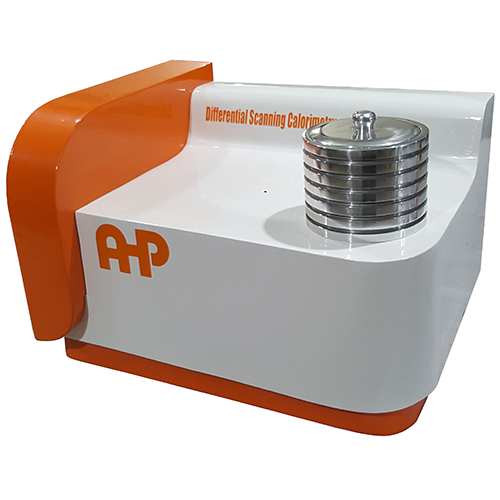
Overview
The Oxidative Induction Time (OIT) test is used to evaluate the oxidative stability and stabilization level of polyolefin materials by Differential Scanning Calorimetry (DSC).
The method is applicable to fully stabilized and compounded polyolefin materials. During the test, the specimen is first heated in an inert nitrogen atmosphere. After reaching the specified test temperature and completing the stabilization period, the atmosphere is changed from nitrogen to oxygen.
The specimen is then maintained at a constant temperature until an exothermic oxidation reaction is detected by the DSC.
The time between the introduction of oxygen and the onset of oxidation is reported as the Oxidative Induction Time (OIT), in minutes.
Applicable Standard
ASTM D3895 – Standard Test Method for Oxidative-Induction Time of Polyolefins by Differential Scanning Calorimetry
ASTM D3895 and ISO 11357-6 address the same general subject; however, their technical requirements are not identical.
Test Principle
The polymer specimen and an empty reference pan are placed in the DSC measuring cell.
The specimen is heated at a controlled rate under a continuous flow of high-purity nitrogen.
After reaching the selected test temperature, the specimen is maintained isothermally for a defined equilibration period.
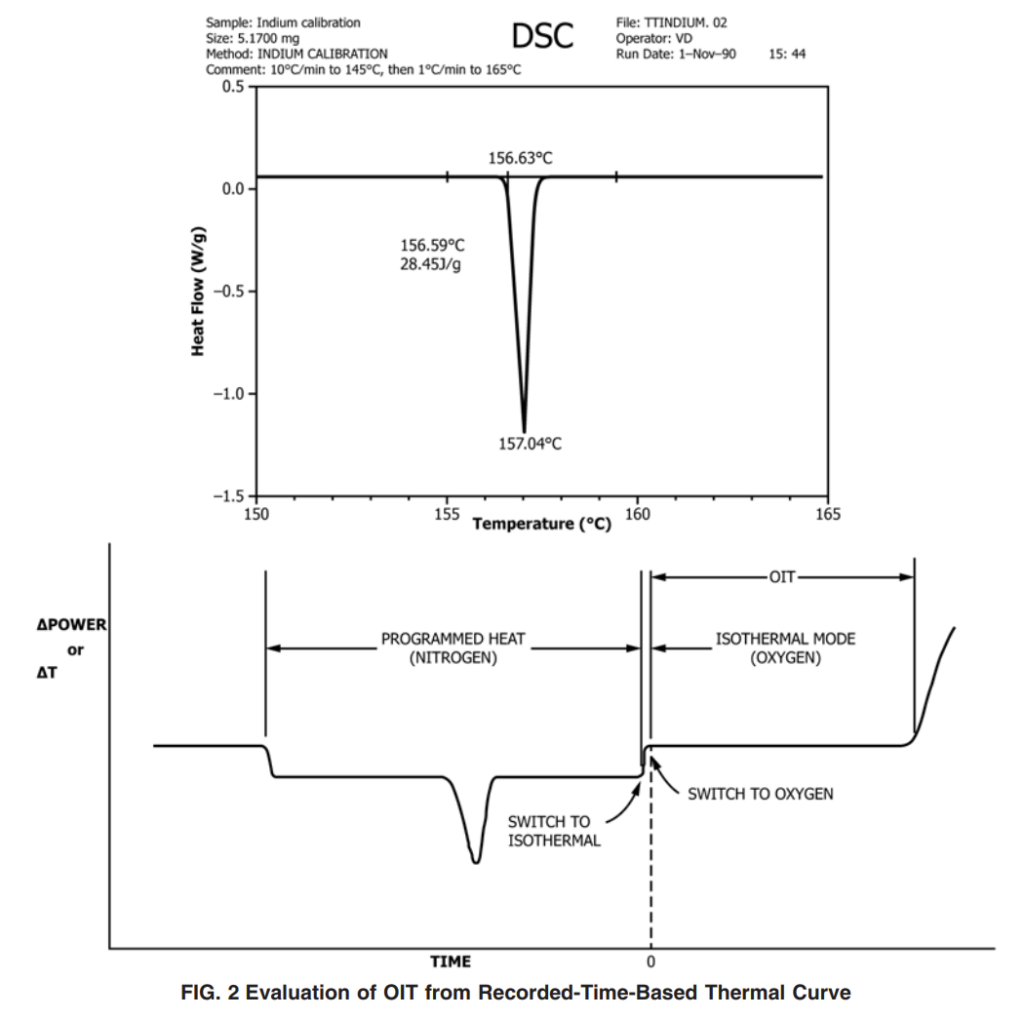
The purge gas is then changed from nitrogen to oxygen.
The moment at which oxygen is introduced into the DSC cell is defined as zero time.
The specimen remains at the selected constant temperature until oxidation begins.
Oxidation produces an exothermic reaction that appears as an increase in the DSC heat-flow signal.
The OIT value is the time interval between oxygen introduction and the determined onset of the oxidation exotherm.
Applicable Materials
The method can be used for stabilized polyolefin materials including:
- High-Density Polyethylene (HDPE)
- Low-Density Polyethylene (LDPE)
- Linear Low-Density Polyethylene (LLDPE)
- Polypropylene
- Polyethylene pipes and fittings
- Geomembranes
- Polyolefin films
- Wire and cable compounds
- Polyolefin raw materials
- Finished polyolefin products
Device Requirements
Differential Scanning Calorimeter
The DSC equipment shall be capable of measuring heat flow with a minimum full-scale capability of 10 mW.
The measuring system shall be capable of displaying or recording:
- Heat flow or temperature difference on the Y-axis
- Time on the X-axis
- Controlled heating programs
- Isothermal temperature operation
- Gas atmosphere changes
- Oxidation exotherm
The time base shall have an accuracy of approximately ±1% and shall be readable to 0.1 minute.
Gas Switching System
The DSC shall be equipped with a gas-selection system for switching between high-purity nitrogen and high-purity oxygen.
The distance and internal volume between the gas switching point and the DSC cell shall be sufficiently small to allow transition to the oxygen atmosphere in less than one minute.
At a gas flow rate of 50 mL/min, the switching volume should be less than approximately 50 mL.
Gas Flow Control
Gas flow shall be controlled or verified using an appropriate device such as:
- Electronic mass flow controller
- Calibrated rotameter
- Suitable calibrated gas flowmeter
The standard test gas flow is: 50 ± 5 mL/min
Nitrogen
Ultra-high-purity, extra-dry nitrogen shall be used during heating and thermal equilibration.
Oxygen
Ultra-high-purity, extra-dry oxygen shall be used during the oxidation stage.
Oil and grease shall be kept away from oxygen equipment because oxygen strongly accelerates combustion.
Analytical Balance
An analytical balance with a sensitivity of 0.1 mg is required.
Sample Pans
Degreased aluminum pans or oxidized copper pans may be used depending on the material and application.
Typical pan dimensions are:
- Diameter: 6.0 to 7.0 mm
- Height: approximately 1.5 mm
An identical empty pan shall be used as the reference pan.
The specimen pan used during the OIT measurement shall not be crimped or hermetically sealed.
Additional Sample Preparation Equipment
Depending on the material form, the following equipment may be required:
- 6.4 mm bore-hole cutter
- Compression molding press
- Spacer plates
- Shim stock
- Caul plates
- PET film or PTFE-coated cloth
- Thickness gauge
- Forceps
- Scalpel
- Cutting board
Test Temperature
Unless otherwise specified, the normal test temperature is: 200 °C
For materials having relatively low or high stabilization levels, another temperature may be selected to obtain a clearly interpretable oxidation curve.
A typical test temperature range is: 180 °C to 220 °C
The actual test temperature shall be stated in the test report.
Sample Preparation
For consistent specimen morphology and mass, ASTM D3895 recommends preparing the polymer as a compression-molded sheet.
Recommended sheet thickness: 250 ± 15 µm
A circular specimen is then cut from the prepared sheet.
Recommended specimen diameter: 6.4 mm
A specimen of this size normally has a mass of approximately: 5 to 10 mg
The exact mass depends on the density of the polymer.
Poor sample uniformity may adversely affect test repeatability.
Compression Molding Procedure
Place the required amount of polymer in the center of an appropriately sized spacer.
Position the material between PET film or PTFE-coated cloth and suitable caul plates.
Place the assembly into the compression molding press.
Typical molding temperatures are:
Polyethylene: 160 °C
Polypropylene: 190 °C
Apply appropriate pressure and molding time to obtain a uniform plaque.
After molding, remove the plaque and cool it to ambient temperature between thick steel plates.
Alternatively, suitable quench cooling may be used.
Measure the average plaque thickness and verify that it is within the required range.
Cut a 6.4 mm diameter specimen disk from the plaque.
Measure and record the specimen mass.
Place the specimen into the appropriate DSC pan.
Place an identical empty pan in the reference position.
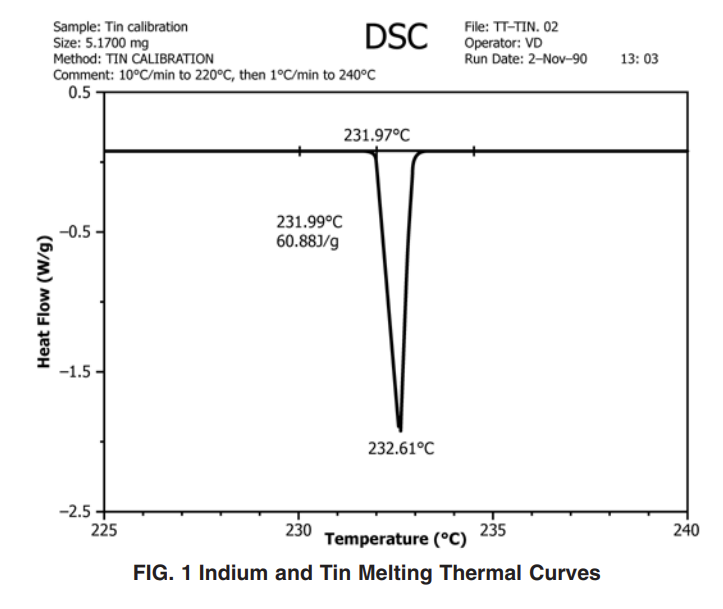
Temperature Calibration
Accurate DSC temperature calibration is important because OIT results are strongly affected by test temperature.
ASTM D3895 specifies a two-point calibration using indium and tin.
Calibration Materials
Indium purity: 99.999%
Tin purity: 99.999%
Reference Melting Temperatures
Indium: 156.63 °C
Tin: 231.97 °C
Calibration Sample Mass
Use approximately: 5 ± 0.5 mg
of the calibration material.
Place the calibration material into an aluminum sample pan and seal it with an aluminum lid.
Prepare an empty sealed aluminum pan as the reference.
Calibration Atmosphere
Use nitrogen at approximately: 50 mL/min
Indium Calibration Program
Heat from ambient temperature to 145 °C at: 10 °C/min
Then heat from 145 °C to 165 °C at: 1 °C/min
Tin Calibration Program
Heat from ambient temperature to 220 °C at: 10 °C/min
Then heat from 220 °C to 240 °C at: 1 °C/min
Adjust the DSC temperature calibration so that the measured melting onset corresponds to:
Indium: 156.63 °C
Tin: 231.97 °C
The instrument should be calibrated at least once per month or before use if more than one month has elapsed since the previous calibration.
Detailed OIT Test Procedure
Step 1 – Load the Specimen
Place the prepared polymer specimen in the appropriate DSC pan.
Install the specimen pan in the sample position.
Install an identical empty pan in the reference position.
Step 2 – Nitrogen Pre-Purge
Start the high-purity nitrogen flow.
Set the nitrogen flow to: 50 ± 5 mL/min
Allow the DSC cell to purge with nitrogen for approximately: 5 minutes
This pre-purge removes residual oxygen from the DSC cell before heating.
Step 3 – Heating
Under continuous nitrogen flow, heat the specimen from ambient temperature to the selected test temperature.
For the standard 200 °C test condition, use a heating rate of:
20 °C/min
Continue heating until the specimen reaches:
200 °C
Step 4 – Thermal Equilibration
After reaching the test temperature, stop the programmed temperature increase.
Maintain the specimen isothermally at the test temperature.
Allow the specimen to equilibrate for: 5 minutes
Continue nitrogen flow during this period.
Step 5 – Switch to Oxygen
At the end of the 5-minute equilibrium period, switch the purge gas from nitrogen to oxygen.
Set the oxygen flow to: 50 ± 5 mL/min
The moment at which oxygen flow is initiated is considered: ZERO TIME
The data acquisition system shall record this changeover point.
Step 6 – Isothermal Oxidation Stage
Maintain the specimen at the selected test temperature under oxygen flow.
Continue recording the heat-flow signal.
As oxidation begins, an exothermic increase in heat flow will appear on the DSC curve.
Continue the isothermal test until the oxidation exotherm has developed sufficiently for reliable analysis.
Normally, the test may continue until the maximum exothermic response has been reached.
Step 7 – Completion of the Test
After completion of the measurement, switch the gas supply back to nitrogen.
Cool the DSC cell toward ambient temperature.
When additional tests are to be performed, cooling the DSC cell below approximately 60 to 70 °C is generally sufficient to reduce the risk of premature thermal oxidation of the next specimen.
Step 8 – Number of Tests
Samples shall be tested at least in duplicate.
The mean OIT result shall be reported.
Determination of OIT
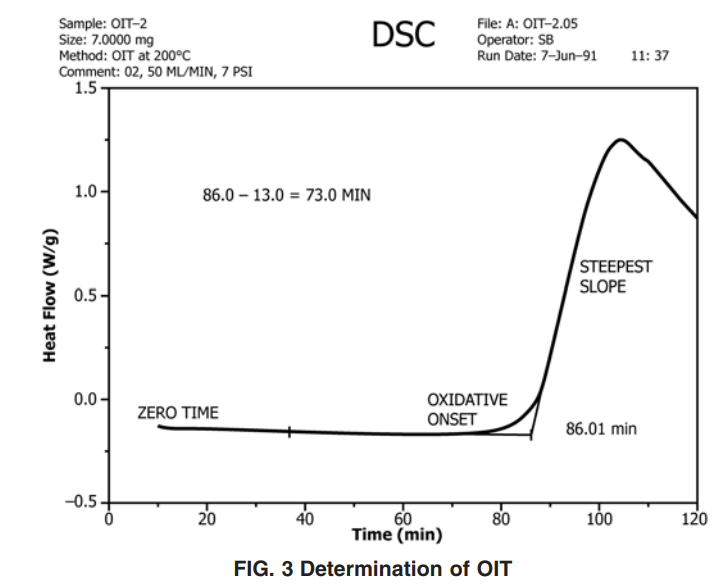
The DSC data are evaluated with heat flow normalized to specimen mass, normally expressed in W/g, plotted against time.
The oxidation onset is determined from the exothermic portion of the thermal curve.
Extend the stable baseline through the oxidation region.
Determine the steepest approximately linear portion of the oxidation exotherm.
Draw or calculate a tangent through this region.
The intersection between the extrapolated tangent and the extended baseline represents the oxidation onset.
The Oxidative Induction Time is the time between:
- Zero time, when oxygen is introduced
- The oxidation onset intersection point
The OIT shall be determined to approximately: 0.1 minute
Tangent Method
The tangent method is the preferred method for determination of OIT.
The baseline before oxidation is extrapolated.
A tangent is drawn along the steepest slope of the exothermic oxidation curve.
The intersection of the tangent and the baseline defines the oxidation onset.
OIT is calculated from zero time to this intersection point.
Offset Method
If the oxidation onset cannot be clearly determined using the tangent method, an offset method may be used.
A second line is drawn parallel to the original baseline at: 0.05 W/g
above the original baseline.
The intersection between this offset line and the oxidation signal may be used to define the oxidation onset. The measurement technique used shall be identified in the test report.
DSC Cell Cleaning
Contamination in the DSC cell may influence subsequent measurements.
ASTM D3895 describes cleaning the DSC cell by heating it in air or oxygen to: 500 °C
for approximately: 5 minutes
Cleaning may be performed before measurements and between materials having different formulations.
Test Report
The test report should include at least the following information:
- Sample identification
- Material description
- Specimen mass
- Type of sample pan
- Test temperature
- Nitrogen flow rate
- Oxygen flow rate
- Measurement technique
- Tangent method or offset method
- Individual OIT results
- Average OIT value
- OIT expressed in minutes
The average OIT should be reported in minutes using three significant digits.
Interpretation of Results
A longer OIT generally indicates a higher resistance to oxidative degradation under the specified test conditions.
The result is particularly useful for quality control and evaluation of the stabilization level of formulated polyolefin materials.
OIT is an accelerated thermal oxidation measurement and should not automatically be interpreted as the actual service life of a polymer product.
Comparisons are most meaningful when materials are tested using the same:
- Test temperature
- Sample preparation
- Specimen mass
- Pan type
- Gas purity
- Gas flow rate
- DSC configuration
- OIT evaluation method
Important Test Parameters
Standard test temperature: 200 °C
Typical selectable test range: 180 to 220 °C
Heating rate: 20 °C/min
Nitrogen pre-purge: 5 minutes
Thermal equilibration: 5 minutes
Nitrogen flow: 50 ± 5 mL/min
Oxygen flow: 50 ± 5 mL/min
Recommended specimen thickness: 250 ± 15 µm
Specimen diameter: 6.4 mm
Typical specimen mass: 5 to 10 mg
Analytical balance sensitivity: 0.1 mg
Minimum number of measurements: 2
OIT resolution: 0.1 minute
Applications
OIT testing is widely used for:
- Quality control of polyethylene and polypropylene compounds
- Evaluation of antioxidant stabilization
- Polyethylene pipe materials
- Geomembranes
- Plastic films
- Wire and cable compounds
- Raw material inspection
- Production quality control
- Research and development
- Comparison of stabilized polymer formulations
- Evaluation of finished polyolefin products
Safety
Oxygen is a powerful oxidizing gas and can greatly accelerate combustion.
All oxygen regulators, tubing, valves and connections must be suitable for oxygen service and must be kept free from oil and grease.
Compressed nitrogen and oxygen cylinders shall be handled and stored according to applicable compressed-gas safety procedures.