
1 Scope*
1.1 This practice provides a uniform basis of evaluating, in a laboratory, the ability of shipping units to withstand the distribution environment. This is accomplished by subjecting them to a test plan consisting of a sequence of anticipated hazard elements encountered in various distribution cycles. This practice is not intended to supplant material specifications or existing preshipment test procedures.
1.2 Consider the use of Practice D7386 for testing of packages for single parcel shipments.
1.3 The suitability of this practice for use with hazardous materials has not been determined.
1.4 The values stated in inch-pound units are to be regarded as standard. The values given in parentheses are mathematical conversions to SI units that are provided for information only and are not considered standard.
1.5 This standard does not purport to address all of the safety concerns, if any, associated with its use. It is the responsibility of the user of this standard to establish appropriate safety and health practices and determine the applicability of regulatory limitations prior to use.
7 Acceptance Criteria
7.1 Acceptance criteria must be established prior to testing and should consider the required condition of the product at receipt. The organizations conducting the test may choose any acceptance criteria suitable for their purpose. It is advisable to compare the type and quantity of damage that occurred to the test specimens with the damage that occurs during actual distribution and handling or with test results of similar containers whose shipping history is known.
7.2 In many cases, the acceptance criteria can be the following:
Criterion 1—Product is damage-free.
Criterion 2—Package is intact.
Criterion 3—Both criteria 1 and 2.
Often, this means that the shipping container and its contents are suitable for normal sale and use at the completion of the test cycle. Detailed acceptance criteria may allow for accepting specified damage to a product or its package. The form andcontent of acceptance criteria may vary widely, in accordance with the particular situation. Methods may range from simple pass-fail judgments to highly quantitative scoring or analysis systems.
8 Procedure
8.1 Define Shipping Unit—Describe shipping unit in terms of size, weight, and form of construction. See 3.2.7. Determine whether the container will be manually or mechanically handled.
8.2 Establish Assurance Level—Specify a level of test intensity. The level should be one of three pre-established assurance levels. This must be pre-established based on the product value, the desired level of anticipated damage that can be tolerated, the number of units to be shipped, knowledge of the shipping environment, or other criteria. Assurance Level II is suggested unless conditions dictate otherwise. Assurance Level I provides a more severe test than II. Assurance Level III provides a less severe test than II. The assurance level may be varied between schedules (see Sections 10 – 15) if such variations are known to occur. The test levels used should be reported. See Section 18.
8.3 Determine Acceptance Criteria—Acceptance criteria are related to the desired condition of the product and package at the end of the distribution cycle. See Section 7.
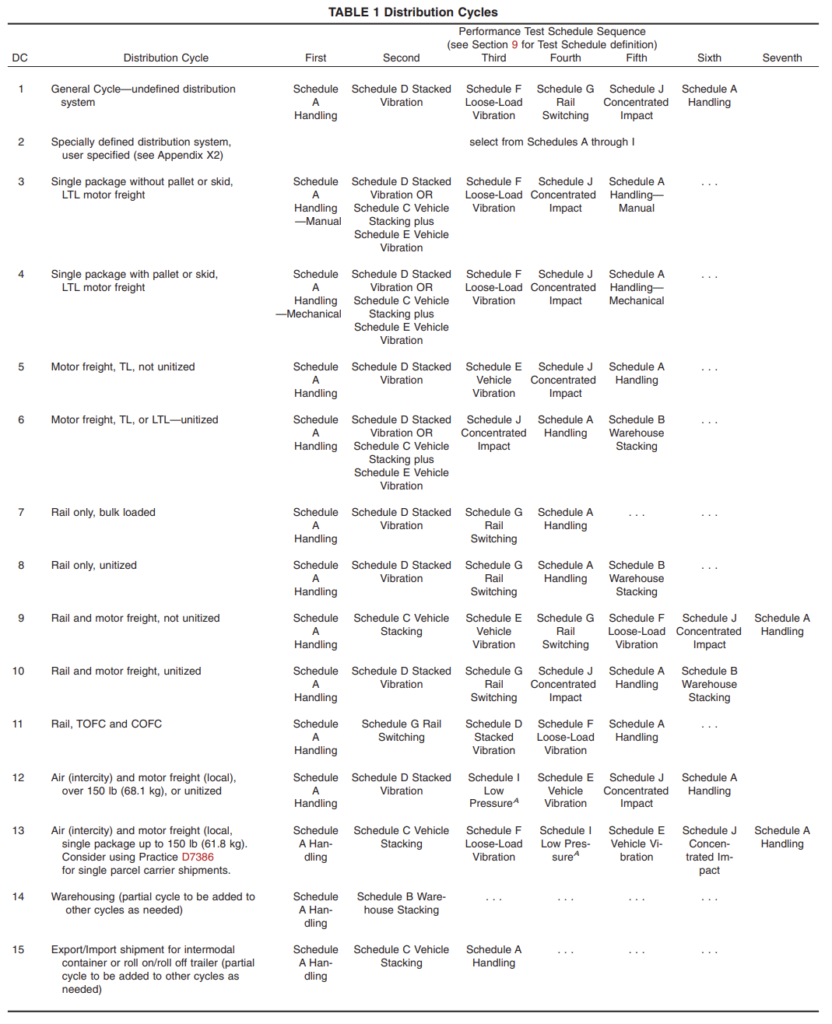
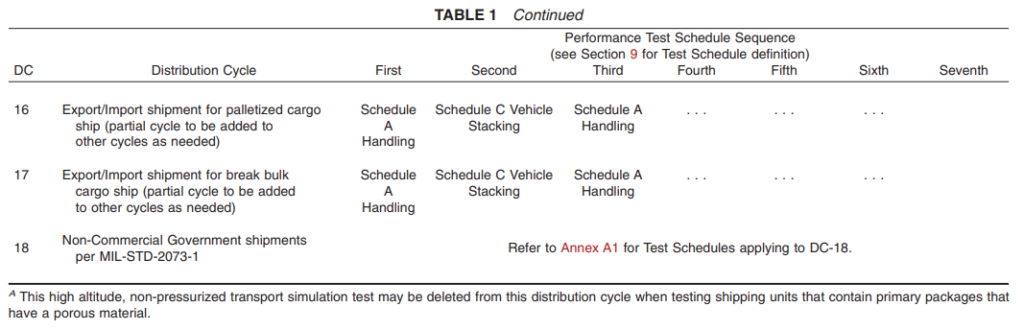
8.4 Select Distribution Cycle—Select a Distribution Cycle from the available standard distribution cycles compiled in Table 1. Use the DC that most closely correlates with the projected distribution. When the distribution is undefined, the general distribution cycle DC-1 should be selected. When the anticipated distribution is well understood, a special distribution cycle DC-2 may be specified. In using DC-2, the user
selects test schedules from Section 9 and specifies the test sequence (see Appendix X2 for more details). For purposes of DC-3 and DC-13, the bottom of a single package is the surface on which the package rests in its most stable orientation. The identified bottom should be utilized for purposes of determining the starting orientation of each test schedule within the above stated distribution cycles.
8.5 Write Test Plan—Prepare a test plan by using the sequence presented in Table 1 for the distribution cycle selected. Obtain the test intensities from the referenced schedules. The test plan intensity details must take into account the assurance levels selected as well as the physical description of the shipping unit. Table 1 thus leads to a detailed test plan consisting of the exact sequence in which the shipping unit will be subjected to the test inputs. The test schedules associated with each element reference the existing ASTM test methods for clarification of the equipment and techniques to be used to conduct the test.
8.5.1 Sample test plans are provided in Appendix X1.
8.6 Select Samples for Test—See Section 5.
8.7 Condition Samples—See Section 6.
8.8 Perform Tests—Perform tests as directed in reference ASTM standards and as further modified in the special instructions for each test schedule.
8.9 Evaluate Results—Evaluate results to determine if the shipping units meet the acceptance criteria. See Section 7.
8.10 Document Test Results—Document test results by reporting each step. See Section 18.
8.11 Monitor Shipments—When possible, obtain feedback by monitoring shipments of the container that was tested to ensure that the type and quantity of damage obtained by the laboratory testing correlates with the damage that occurs in the distribution cycle. This information is very useful for the planning of subsequent tests of similar shipping containers.
9 Hazard Elements and Test Schedules
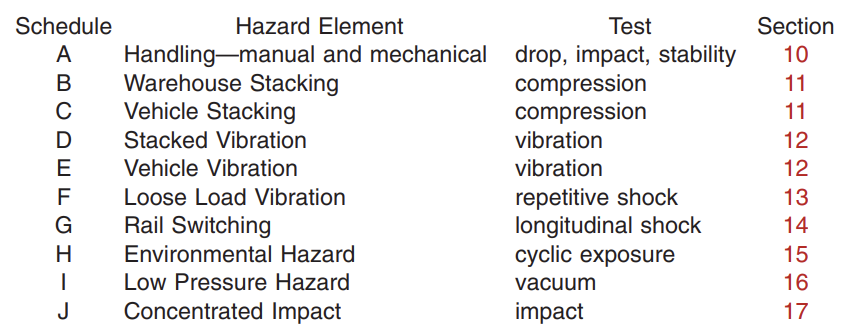
9.1 Hazard Elements and Test Schedules are categorized as follows: