

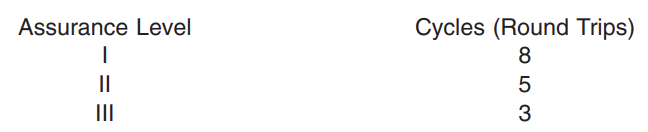
8.2 Establish Assurance Level—Specify a level of test intensity. The level should be one of three pre-established assurance levels. This must be pre-established based on the product value, the desired level of anticipated damage that can be tolerated, the number of units to be shipped, knowledge of the shipping environment, or other criteria. Assurance Level II is suggested unless conditions dictate otherwise. Assurance Level I provides a more severe test than II. Assurance Level III provides a less severe test than II. The assurance level may be varied between schedules (see Sections 10 – 15) if such variations are known to occur. The test levels used should be reported. See Section 18.
10 Schedule A—Handling—Manual and Mechanical:
10.1 There are two types of handling hazard element, manual and mechanical. The manual handling test should be used for single containers, smaller packages, and any shipping container that can be handled manually, up to a weight of 200 lb (90.7 kg). Mechanical handling should be used for unitized loads, large cases and crates, and any shipping container or system that will be handled by mechanical means. Manual and mechanical handling are described further in 10.2 and 10.3.
10.2 Manual Handling—The test levels and the test method for this schedule of the distribution cycle are intended to determine the ability of the shipping unit to withstand the hazards occurring during manual handlings, such as loading, unloading, stacking, sorting, or palletizing. The main hazards from these operations are the impacts caused by dropping or throwing. Size, weight, and shape of the shipping unit will affect the intensity of these hazards. Several test method options are permitted, including free fall and simulated drop test using shock machines. While these test methods producesimilar results, the shock machine method produces more control of orientations of impact; see Test Method D5487 for limitations of the shock machine method.
10.2.1 For long narrow packages that are mechanically sorted, another hazard to be simulated is bridge impact (10.2.4).
10.2.2 Mechanical handling (10.3) may be used when it is anticipated that handling will be by mechanical means only.
10.2.3 For the free-fall and shock machine tests, recommended drop heights, the number of drops, the sequence of drops, and the shipping unit orientation at impact are as follows:
Test Method D5276, D5487.
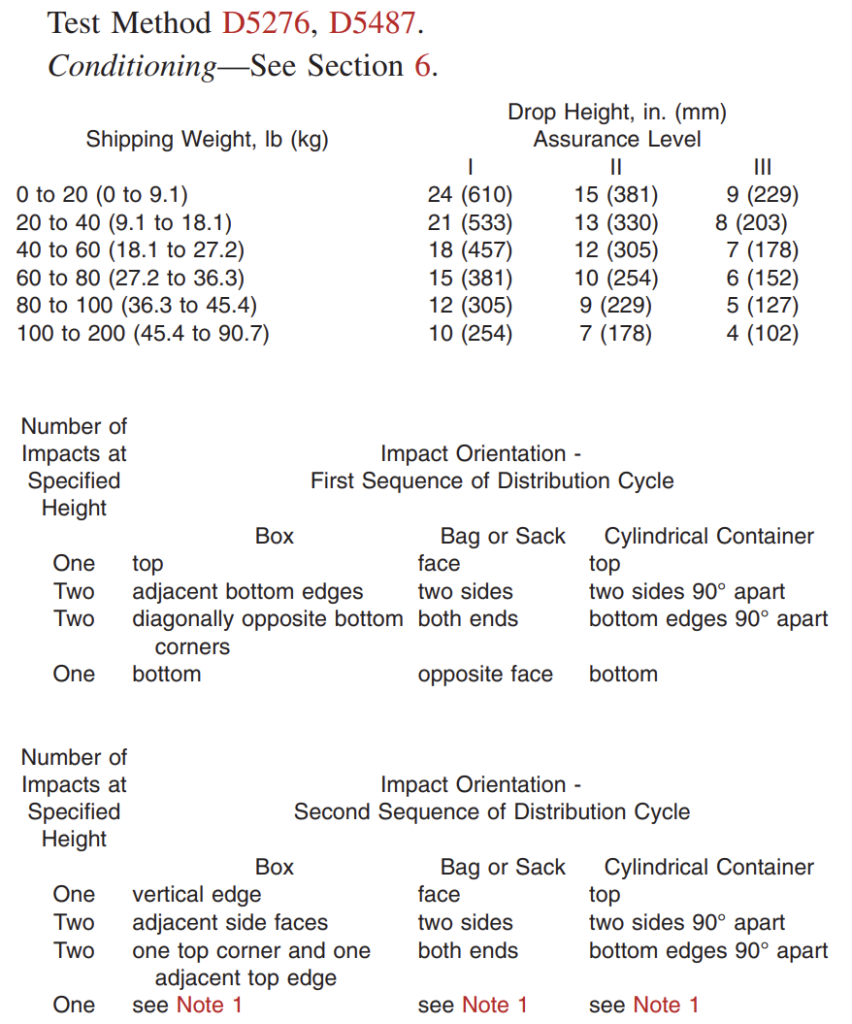
NOTE 1—On the last impact of the last manual handling sequence in a distribution cycle, the impact should be made at twice the specified height or equivalent velocity change. (This is the final (sixth) drop in the sequence, not an additional drop.) The drop should be in the impact orientation most likely for a drop to occur, usually the largest face or the bottom. For distribution cycles where any drop orientation is possible (that is, shipments via carriers that mechanically sort packages), this drop should be in the most critical or damage-prone orientation, as defined in Test Method D5276.
NOTE 2—The equivalent velocity change corresponding to the specified drop height used for the shock machine method shall be calculated as specified in Test Method D5487.
10.2.4 Bridge Impact Test: Test Method—D5265. Conditioning—See Section 6.
10.2.4.1 Conduct bridge impacts on long, narrow shipping units which have a length of at least 36 in. (915 mm) and each of the other two dimensions are 20 % or less of the longest dimension.
10.2.4.2 These tests are required only once in any test schedule sequence.
10.3 Mechanical Handling—The test levels and the test method for this schedule of the distribution cycle are intended to determine the ability of large and heavy shipping units, single packages with pallet or skid, and unitized loads to withstand the mechanical handling hazards that occur during loading, unloading, sorting, or stacking. For large shipping cases and crates and any single package with pallet or skid, different test methods are used versus unit loads. For various types of unit loads, test methods also vary, depending on the method of truck handling: fork, clamp, spade, or pull/pack.
10.3.1 Large Shipping Cases and Crates and Single Packages with Pallet or Skid—Perform the following test sequences:
Test Method—D6179, D880, D4003. Conditioning—See Section 6.
10.3.1.1 Fork Lift Truck Handling—One rotational flat drop from each opposite base edge in accordance with Method C of Test Methods D6179 and one rotational drop on each of two diagonally opposite base corners in accordance with Method B of Test Methods D6179.

10.3.1.2 Crane Handling—(Conduct this test only if cranes are used for handling in the distribution process.) One drop flat on bottom and one drop on base edge in accordance with Method D of Test Methods D6179. Use the same drop heights versus shipping unit weight as in 10.3.1.1.
10.3.1.3 Side Impact Test—Impact all four sides of the shipping unit in accordance with Test Method D880, Procedure
B. Alternately, use Test Method D4003 Method B using a short duration programmer, assuming the coefficient of restitution is 0.0 and the total velocity change is equivalent to the specified impact velocity.
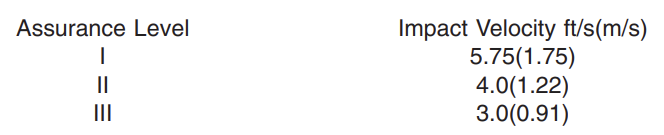
10.3.1.4 Tip Test—In accordance with Method F of Test Methods D6179.
10.3.1.5 Tipover Test—In accordance with Method G of Test Methods D6179 if shipping unit fails Tip Test above.
10.3.2 Unitized Loads—Perform the following tests sequences as appropriate for the method of truck handling:
Test Method—D880, D4003, D6055, D6179. Conditioning—See Section 6.
10.3.2.1 All Methods of Truck Handling—Pick up, transport around test course, and set down in accordance with Test Methods D6055, Method A for fork lift, Method B for spade lift, Method C for clamp, and Method D for pull pack.
(1) For shipments via less-than-truckload (LTL), simulate transfer terminal handling by performing fork lift truck transport over a floor hazard described as follows: a modified nominal 2 by 6 in. board with one edge beveled full height at 45° (see Fig. 1) shall be placed on the course in a position where both lift truck wheels on one side must pass over it during each handling sequence, and a second modified nominal
2 by 6 in. board shall be placed on the course after the 90° turn in such a position that both lift truck wheels on the opposite side must pass over it during each handling sequence.
10.3.2.2 All Methods of Truck Handling—Impact all four sides of the shipping unit in accordance with Test Method D880 Procedure B. Alternately, use Test Method D4003, Method B using a short duration programmer, assuming the coefficient of restitution is 0.0 and the total velocity change is equivalent to the specified impact velocity.

10.3.2.3 Fork Lift Truck Handling—One rotational flat drop from each opposite base edge in accordance with Method C of Test Methods D6179.
