

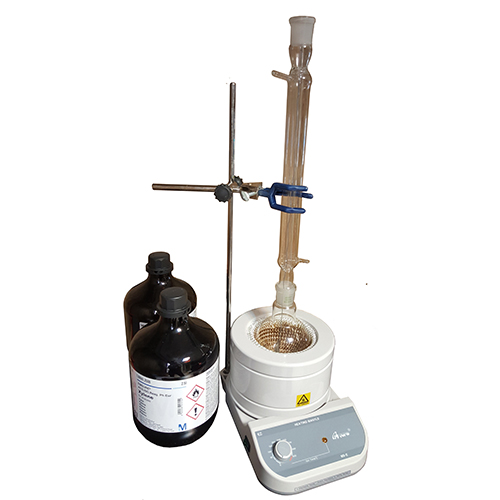
How can we evaluate whether polyethylene has been adequately crosslinked?
One of the most widely used approaches is to determine its Gel Content and, when required, its Swell Ratio.
ASTM D2765 describes test methods for determining the insoluble fraction produced by crosslinking in ethylene plastics. The methods are applicable to crosslinked polyethylene materials of different densities, including compounds containing fillers.
What is Gel Content?
During crosslinking, polyethylene chains become interconnected and form a three-dimensional polymer network. When a crosslinked polyethylene sample is exposed to an appropriate hot solvent:
Soluble polymer fraction → extracted by the solvent
Crosslinked network → remains as an insoluble gel
ASTM D2765 defines Gel Content as the percentage by mass of polymer that remains insoluble in a specified solvent after extraction under specified conditions.
This makes gel content particularly useful for process control and finished-product quality evaluation, since many important properties of crosslinked ethylene plastics vary with gel content.
Three Test Methods in ASTM D2765
The standard describes three approaches:
Method A — Referee Test Method
The reference method provides the most complete extraction in the shortest specified time. The polymer is ground and screened before extraction.
Method B — Nonreferee Test Method
Primarily intended for wire and cable insulation. The extraction procedure is similar to Method A, but sample preparation is different. Because the shaved particles are larger, Method B normally produces extraction values approximately 1–2% lower than Method A.
Method C — Nonreferee Test Method
A one-piece specimen is extracted in xylene. This method allows both Percent Extract and Swell Ratio to be determined. Extraction values can be approximately 3–9% lower than the referee method because of the different specimen geometry and extraction conditions.
Method A — Referee Method
Required Equipment
The main equipment specified for Method A includes:
• Round-bottom flask — 500 mL for one or two determinations or 2000 mL for several determinations, up to six
• Heating mantle with sufficient capacity to boil the extraction solvent
• Reflux condenser
• Ring stand and clamps
• Grinding equipment capable of producing a 30–60 mesh fraction without excessive heating
• U.S. No. 30 and No. 60 sieves
• 120-mesh stainless-steel wire cloth
• Vacuum oven capable of at least 710 mmHg vacuum and temperature measurement up to 150°C
• Analytical balance readable to 0.001 g
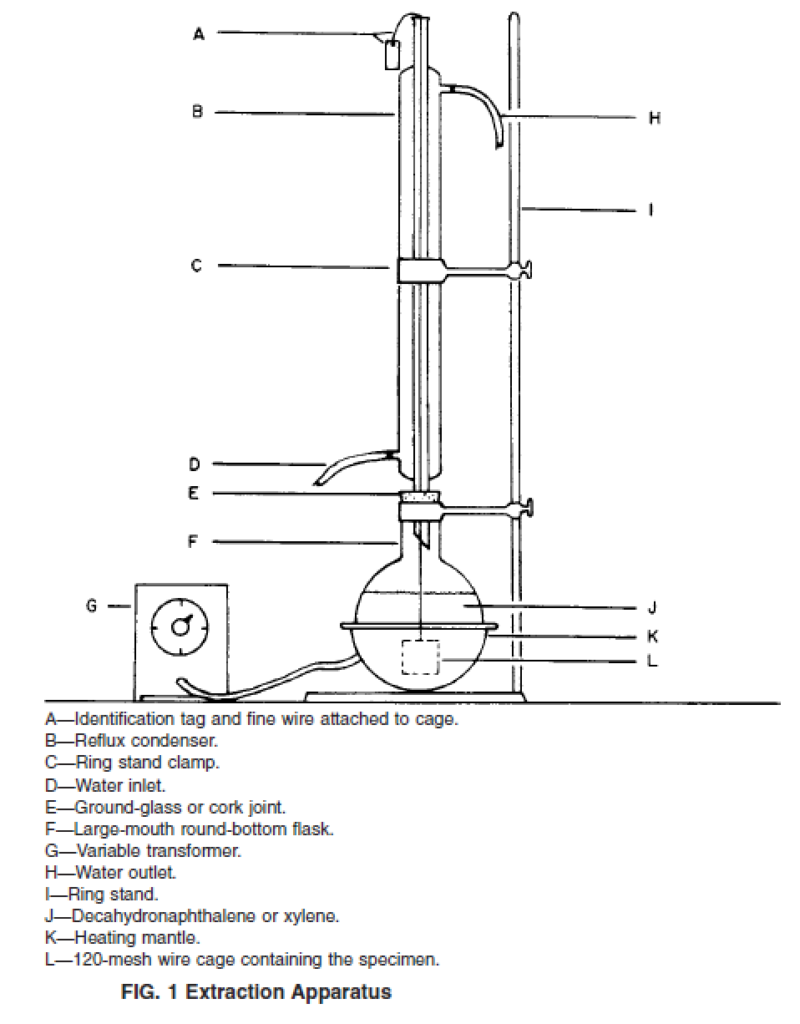
The extraction apparatus shown in Figure 1 consists of a round-bottom flask, heating mantle, reflux condenser, support stand, extraction solvent, and a suspended 120-mesh wire cage containing the specimen.
Reagents
ASTM D2765 specifies:
• Decahydronaphthalene (Decalin) — anhydrous, boiling point 189–191°C
• Xylenes — ACS reagent grade, boiling point 138–141°C
• A suitable antioxidant/stabilizer for the extraction solvent
The antioxidant is used to inhibit possible oxidative degradation during high-temperature extraction.
Specimen Preparation
At least two specimens are required.
Each specimen should contain: 0.300 ± 0.015 g of ground polymer
and should be weighed to the nearest: 0.001 g
The sample is ground sufficiently to pass through a 30-mesh sieve. The material is then shaken over a 60-mesh sieve, and the fraction passing through the 60-mesh sieve is rejected.
Therefore, the test fraction is essentially the material retained between 30 and 60 mesh.
Where conditioning is required, the standard specifies conditioning at: 23 ± 2°C for at least 40 hours
in accordance with ASTM D618 Procedure A.
Method A — Test Procedure
1. Prepare the specimen cage
A piece of 120-mesh stainless-steel cloth, approximately: 80 × 40 mm
is folded to form a pouch approximately 40 mm square. The empty pouch is weighed:
W1 = weight of the pouch
Approximately 0.3 g of the prepared sample is then placed inside:
W2 = weight of pouch + specimen
The open side is folded and stapled to form a closed cage:
W3 = weight of closed cage + specimen
2. Prepare the extraction solvent
Enough solvent must be added to keep the cage and specimen completely immersed throughout extraction. The standard gives the following quantities as sufficient:
500-mL flask → approximately 350 g solvent
2000-mL flask → approximately 1000 g solvent
In addition, 1% antioxidant is dissolved in the Decalin or xylene.
3. Perform solvent extraction
The solvent is boiled vigorously enough to provide good agitation. When using 1000 g of solvent, a reflux rate of approximately: 20–40 drops/min from the condenser is considered satisfactory.
Specified extraction times are:
Decalin → 6 hours
Xylenes → 12 hours
For referee testing, the specified extraction time should be followed.
4. Vacuum drying
Immediately after extraction, the cage and specimen are transferred to a vacuum oven preheated to: 150°C
The sample is dried to constant weight under at least: 710 mmHg vacuum
After cooling, the final weight is recorded as:
W4 = weight of cage + specimen after extraction and drying
If the compound absorbs moisture, the specimen should be cooled in a desiccator before weighing.
Calculation of Gel Content
The extraction percentage is calculated from the mass lost during solvent extraction, with correction for insoluble filler when applicable. The key relationship is:
Gel Content (%) = 100 − Extract (%)
Where:
W1 = weight of the pouch
W2 = weight of specimen + pouch
W3 = weight of specimen + closed cage before extraction
W4 = weight of specimen + cage after extraction and drying
F = fraction of insoluble filler in the polyethylene compound
If filler content is unknown, ASTM D2765 refers to ASTM D1603 or ASTM D297 for its determination.
Method C — Going Beyond Gel Content
Gel Content tells us how much polymer remains insoluble, but Swell Ratio provides additional information about the crosslinked network itself.
In Method C, specimens are weighed, immersed in hot xylene for 24 hours, weighed in their swollen condition, then vacuum-dried and weighed again.
Both Percent Extract and Swell Ratio can then be calculated.
Equipment Required for Method C
• Agitated oil bath at 110°C
• 8-oz wide-mouth glass jars with screw caps
• Analytical balance accurate to 0.001 g
• 250-mm forceps
• Specimen cutting devices
• Vacuum oven at 100°C, with vacuum pump and cold trap
• 100-mL flasks
• Desiccator with drying agent
• 30-mL and 60-mL weighing bottles
• 100-mL pipette or bottle-top dispenser
Specimen Requirements
At least two specimens are required, each containing: 0.500 ± 0.020 g of polymer
The specimens should have smooth, clean edges and as low a surface-to-volume ratio as reasonably possible.
Method B — Nonreferee Method for Wire and Cable Insulation
Method B is particularly important for XLPE-insulated wire and cable. Unlike Method A, the polymer is not ground into a 30–60 mesh fraction. Instead, a specimen is physically removed from a selected location within the insulation.
The standard specifically notes that Method B differs from Method A primarily in specimen preparation.
Why is the Sampling Location Important?
For cable insulation, crosslinking may not necessarily be uniform throughout the insulation thickness.
Method B therefore allows the test specimen to be taken from a region of interest, particularly an area that may be susceptible to insufficient crosslinking.
The sampling concept is illustrated in Figure 2, showing the cross-section of a high-voltage cable and the location of the specimen near the conductor or semiconducting strand shield.
Additional Sample-Preparation Equipment
In addition to the extraction equipment used for Method A, Method B requires a suitable means of preparing shaved insulation specimens.
The standard specifically describes using a: Wood plane
to shave the insulation. Cutting tools are then required to prepare the final diced specimens.
Step 1 — Shave the Insulation
Using a wood plane, shave a strip approximately: 0.4 mm thick
parallel to the axis of the insulated conductor.
For constructions without strand shielding tapes or compounds, the extraction strip is taken next to the conductor. For high-voltage cables using strand shielding tapes or compounds, the strip should be shaved as closely as possible along the shielded surface, while taking care not to include any semiconducting compound in the specimen.
This sampling detail is critical because contamination with semiconductive shield material would affect the composition of the specimen being evaluated.
Step 2 — Prepare the Extraction Pieces
A longitudinal section approximately: 6 mm wide
is cut through the center portion of the shaved strip. The outer sections are discarded, leaving material closest to the conductor or shielded surface.
This material is then cut or diced into pieces approximately: 6 × 6 mm
For cable sizes 1/0 AWG and larger, these dimensions apply directly. For 2 AWG and smaller, the dimensions should be proportionally reduced.
Step 3 — Load the Specimen
Place approximately: 0.3 g
of the diced specimen into a previously weighed pouch.
Record:
W1 = weight of pouch
After adding the specimen:
W2 = weight of pouch + specimen
Fold and staple the open side to form the cage:
W3 = weight of cage + specimen
Step 4 — Extraction
The extraction is then performed according to Section 12 of Method A, but Method B specifies:
Decahydronaphthalene (Decalin) as the extractant
After extraction, the specimen is dried and reweighed using the same procedure described for Method A.
Therefore, the basic workflow becomes:
Shave → Select location → Dice → Weigh → Decalin extraction → Vacuum dry → Reweigh → Calculate
Calculation
Percent solvent extraction is calculated using the same calculation described for Method A:
Gel Content (%) = 100 − Extract (%)
The test report should also explicitly identify that Method B was used.
Why Can Method B Give a Different Result?
This is an important practical point. The shaved and diced particles used in Method B are larger than the ground particles used in Method A.
Therefore:
Larger particles → lower total surface area exposed to solvent → less complete extraction
As a result, ASTM D2765 states that Method B ordinarily produces extraction values approximately:
1–2% lower than Method A
This is why Method B results should not simply be compared numerically with Method A results without identifying the test method used.
Method C — Test Conditions
Each weighed specimen is placed in an 8-oz glass jar and: 100 ± 0.1 mL of xylene
is added. The specimen must remain completely immersed. The jar is then placed in an agitated oil bath maintained at: 110 ± 0.5°C for: 24 hours
After immersion, the swollen specimen is carefully transferred to a tared weighing bottle and weighed.
It is then dried in a vacuum oven at: 100°C
until all xylene has been removed and constant weight is reached.
The standard notes that LDPE-containing formulations commonly require approximately 24 hours, while HDPE-containing formulations commonly require approximately 16 hours to reach weight equilibrium under these conditions.
How Should Swell Ratio Be Interpreted?
The relationship is particularly useful:
Higher Swell Ratio → Lower degree of crosslinking
Lower Swell Ratio → More tightly crosslinked network
Similarly:
Lower Percent Extract → Higher degree of crosslinking
ASTM D2765 explains that a lower swell ratio corresponds to a more tightly bound network and a lower molecular weight between crosslinks.
⚠️ Safety Considerations
Both xylene and decahydronaphthalene are toxic and flammable solvents.
ASTM D2765 requires them to be handled in a properly ventilated hood, with hood effectiveness checked before testing. Exposure to solvent vapors should be avoided.
A Quick Comparison
Method A
Ground 30–60 mesh specimen → Decalin or xylene extraction → Referee method
Method B
Shaved and diced cable insulation → Decalin extraction → Cable-focused nonreferee method
Method C
One-piece specimen → Xylene at 110°C for 24 h → Percent Extract + Swell Ratio
So, the choice of method depends not only on the material but also on what information is required and where the specimen comes from.
Safety Considerations ⚠️
Both xylene and decahydronaphthalene are toxic and flammable solvents.
ASTM D2765 requires these solvents to be handled in a properly ventilated hood, and the effectiveness of the hood should be checked before testing. Inhalation of solvent vapors should be avoided.
Why Does This Test Matter?
Gel Content testing is more than simply measuring an insoluble percentage.
It provides a practical method for evaluating the effectiveness and consistency of the crosslinking process, comparing crosslinked polyethylene materials, and supporting quality control of finished XLPE products.
One important point is that results from Methods A, B, and C should not be treated as directly interchangeable. Differences in specimen preparation, geometry, solvent, temperature, and extraction conditions can systematically affect the measured Percent Extract.
In simple terms:
Weigh → Extract → Dry → Reweigh → Calculate
The soluble fraction is removed, while the remaining insoluble polymer provides a quantitative indication of the crosslinked network.