

Introduction
ISO 11443:2021, Plastics — Determination of the fluidity of plastics using capillary and slit-die rheometers, is an important international standard for the rheological characterization of polymer melts.
The standard specifies methods for determining the flow behavior of plastics under shear rates, shear stresses, and temperatures representative of polymer-processing conditions. Unlike a conventional Melt Flow Rate (MFR/MVR) test, capillary rheometry provides detailed information about the relationship between viscosity, shear rate, shear stress, pressure, temperature, and flow rate.
ISO 11443 covers both:
- Capillary rheometers
- Slit-die rheometers
From an equipment perspective, compliance with ISO 11443 is not determined simply by the maximum temperature or pressure of the instrument. The standard establishes requirements for the barrel, die geometry, piston, temperature-control system, pressure measurement, volumetric flow-rate measurement, and calibration system.
This article focuses specifically on these technical and instrumentation requirements and the characteristics that should be considered when designing, specifying, or selecting a rheometer for testing according to ISO 11443.
Scope of ISO 11443
ISO 11443 specifies methods for determining the fluidity of plastic melts at conditions approaching those encountered during plastics processing.
This is particularly important because polymer melt viscosity is generally dependent not only on temperature but also on shear rate and shear stress.
Depending on the measurement range of the pressure and/or force transducer and the mechanical characteristics of the rheometer, the standard covers melt viscosities approximately within:
10 to 10⁷ Pa·s
Extrusion rheometers can operate over shear rates approximately within:
1 to 10⁶ s⁻¹
The standard also includes methods for evaluating extrudate swell, which results from elongational effects occurring as the polymer enters and exits the die.
Measurement Principle
During a capillary rheometer test, molten polymer is forced through a die of precisely known geometry.
ISO 11443 defines two principal measurement approaches.
Method 1 – Constant Test Pressure
A specified test pressure p is maintained and the resulting volume flow rate Q is measured.
Method 2 – Constant Volume Flow Rate
A specified volume flow rate Q is maintained and the corresponding test pressure p is measured.
These methods can be combined with either capillary or slit-die geometries:
| Die Geometry | Constant Pressure | Constant Volume Flow Rate |
|---|---|---|
| Circular – Capillary Die | A1 | A2 |
| Rectangular – Slit Die | B1 | B2 |
For piston-driven capillary rheometers, accurate control and measurement of piston movement are therefore fundamental to establishing a controlled volumetric flow rate.
1. General Rheometer Configuration
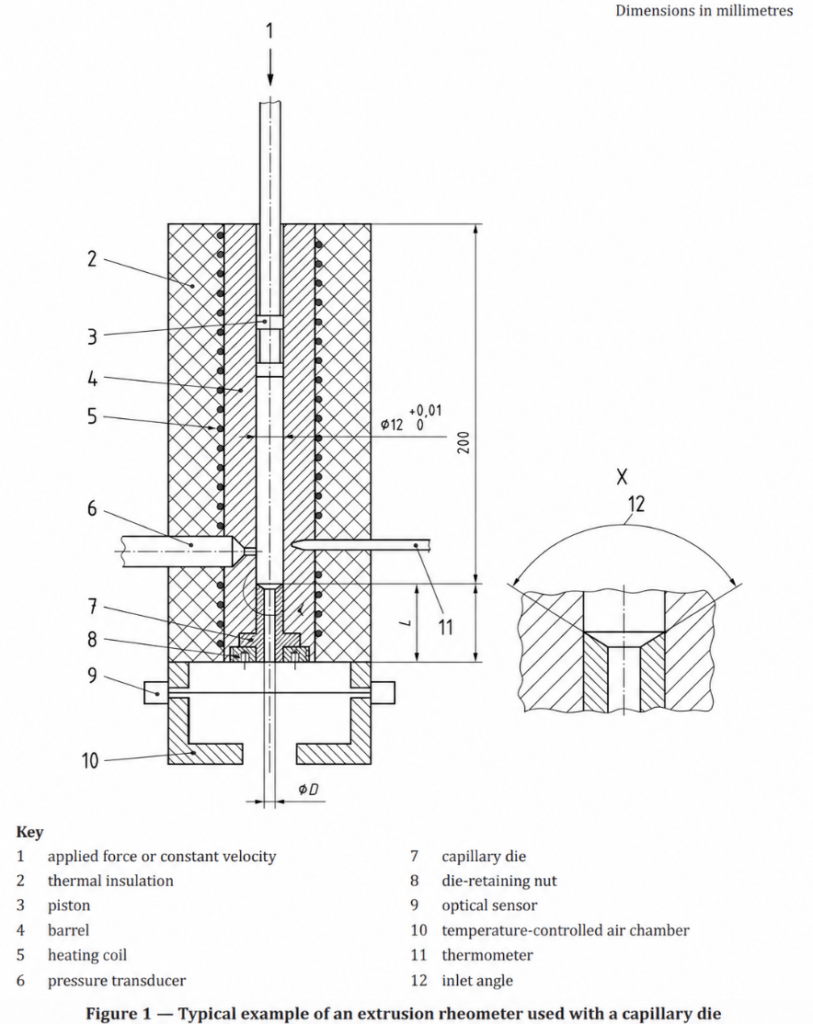
According to ISO 11443, the test device consists of a heatable barrel whose lower end is closed by an interchangeable capillary or slit die.
Pressure can be applied to the polymer melt using:
- a piston,
- a screw, or
- gas pressure.
A typical piston-driven capillary rheometer therefore incorporates:
- precision drive and force application system,
- piston,
- heated barrel,
- heating elements,
- temperature sensors,
- pressure transducer or force measurement system,
- interchangeable die,
- displacement/velocity measurement system,
- data acquisition and control system.
The typical capillary rheometer arrangement shown in ISO 11443 also includes the piston, barrel, heating coil, pressure transducer, capillary die, optical sensor and temperature measurement system.
2. Rheometer Barrel Requirements
The barrel is a critical component because dimensional changes, wear, corrosion, or surface damage can influence the flow conditions and ultimately affect the calculated rheological properties.
Material and Mechanical Resistance
The barrel must be manufactured from a material capable of resisting:
wear and corrosion up to the maximum operating temperature of the heating system.
Barrel Bore Tolerance
The permissible variation in the mean bore diameter over the length of the barrel must be less than:
±0.007 mm
This requirement demonstrates the high level of precision machining required for a capillary rheometer.
Surface Hardness
ISO 11443 specifies a preferred Vickers hardness of at least:
800 HV30
For temperatures up to approximately 400°C, nitrided steel is identified as a suitable material. Other materials can also be acceptable where sufficient corrosion and abrasion resistance are provided.
Surface Roughness
The internal barrel surface should have a roughness below:
Ra = 0.25 µm
The combination of dimensional accuracy, high hardness, low surface roughness, and wear resistance is essential for maintaining reproducible measurement conditions.
These barrel requirements are explicitly specified in ISO 11443.
3. Barrel Diameter
ISO 11443 does not specify one mandatory barrel diameter for all rheometers.
Commercial extrusion rheometers typically have barrel bore diameters ranging approximately from:
6.35 mm to 30 mm
Increasing the barrel diameter can provide advantages such as a larger number of measurements from a single barrel filling and an extended shear-rate range.
However, a larger barrel also requires:
- more sample material,
- greater heating capacity,
- and a longer time to achieve thermal equilibrium throughout the sample.
Therefore, barrel diameter is an important design parameter rather than simply a capacity specification.
4. Capillary Die Requirements
The capillary die is one of the most critical components of the measurement system because its dimensions directly influence the calculated shear rate, shear stress, and viscosity.
Capillary Diameter Accuracy
The complete capillary wall must be machined with a diameter D accuracy of:
±0.007 mm
Capillary Length Accuracy
The die length L must be manufactured to an accuracy of:
±0.025 mm
Surface Roughness
The capillary surface roughness must be less than:
Ra = 0.25 µm
Surface Hardness
The preferred Vickers hardness is at least:
800 HV30
The capillary opening should not exhibit visible machining marks or perceptible eccentricity.
Typical capillary die materials include:
- hardened steel,
- tungsten carbide,
- stellite,
- hardened stainless steel.
The dimensional requirements are particularly important because capillary flow calculations are highly sensitive to die geometry. ISO 11443 therefore emphasizes that the actual dimensions and the accuracy with which they are measured should be known and reported.
5. Capillary Diameter and L/D Ratio
Capillary dies typically used for polymer rheology have diameters approximately within:
0.5 to 2 mm
Larger diameters may be required for highly filled materials.
Different capillary lengths can be used to obtain the required length-to-diameter ratio (L/D).
For accurate rheological characterization, die geometry is especially important because it affects:
- apparent shear rate,
- apparent shear stress,
- pressure drop,
- entrance effects,
- Bagley correction,
- and calculated viscosity.
When results from different instruments or laboratories are compared, precise knowledge of the actual die dimensions is therefore essential.
6. Bagley Correction and Multiple Capillary Dies
Pressure measured upstream of a capillary does not consist exclusively of the pressure drop caused by fully developed shear flow inside the capillary.
Additional pressure losses occur at the die entrance and exit.
Consequently, determination of true wall shear stress can require correction of the measured pressure.
ISO 11443 provides for Bagley correction, in which measurements using capillary dies of the same radius but different lengths can be used to determine the combined entrance and exit pressure losses.
The standard explains that if capillary dies of equal radius but different lengths are used, the entrance and exit pressure contributions can be determined.
Zero-Length Die
An important change introduced in the 2021 edition of ISO 11443 is the addition of a zero-length die.
A zero-length die is specially designed to facilitate rapid determination of entrance pressure losses for Bagley correction, reducing the number of different die lengths required for the correction procedure.
The inclusion of the zero-length die is specifically identified as one of the technical changes in the fourth edition of ISO 11443.
For a modern capillary rheometer, compatibility with multiple interchangeable dies is therefore an important technical feature when corrected rheological data are required.
7. Slit-Die Rheometry
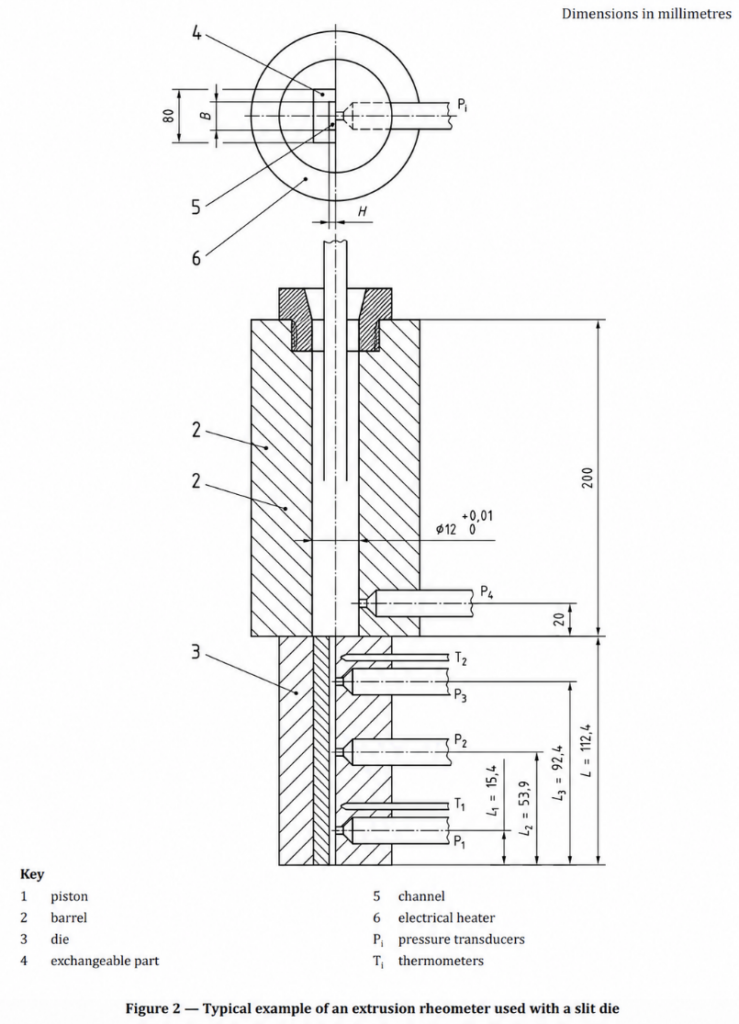
ISO 11443 also supports rectangular slit dies, designated as Method B.
A major advantage of a slit die is the possibility of positioning several pressure transducers along the flow channel.
This configuration enables measurement of the pressure gradient directly along the die rather than relying only on an upstream pressure measurement.
ISO 11443 notes that a slit die equipped with pressure transducers along its length is particularly suitable for automated measurements and computer-based evaluation.
A typical ISO 11443 slit-die configuration includes:
- piston,
- barrel,
- die,
- interchangeable section,
- flow channel,
- electrical heater,
- multiple pressure transducers,
- multiple temperature sensors.
The typical configuration is illustrated in the standard’s slit-die rheometer diagram.
8. Piston System
In a piston-driven capillary rheometer, the piston performs two important functions:
- generating pressure within the polymer melt;
- establishing the volume displacement required to determine or control the flow rate.
The dimensional relationship between the piston and barrel is therefore important because excessive clearance can allow polymer to flow backwards around the piston, whereas insufficient clearance can create excessive friction or mechanical interference.
The drive system should also provide sufficiently precise control of piston displacement and velocity to generate stable and reproducible flow conditions.
For constant-volume-flow testing, this becomes especially important because piston velocity directly determines the volumetric displacement rate when the barrel cross-sectional area is known.
9. Temperature Control
Temperature is one of the most influential parameters in polymer rheology.
Even relatively small changes in melt temperature can produce significant changes in measured viscosity.
For this reason, the thermal system of a capillary rheometer should not be evaluated solely by its maximum temperature.
A suitable system must provide:
- accurate temperature setting,
- stable temperature control,
- adequate temperature uniformity,
- reliable temperature measurement,
- and traceable calibration.
In practice, this requires coordinated operation of the heating system, temperature sensors, controller, barrel geometry, thermal insulation, and data acquisition system.
10. Temperature Measurement
The test temperature should represent the actual temperature of the polymer melt as closely as possible.
The measurement location is therefore important.
A temperature sensor positioned close to the die entrance provides a more representative measurement of the melt condition immediately before the material enters the capillary.
Common temperature measurement technologies for this type of equipment include:
- thermocouples,
- platinum resistance temperature detectors.
For an ISO-oriented instrument specification, the manufacturer should clearly state not only the available temperature range but also:
- temperature resolution,
- control stability,
- temperature uniformity,
- sensor location,
- and calibration method.
11. Pressure Measurement
Pressure measurement is another fundamental part of capillary rheometry.
A melt-pressure transducer can be installed near the die entrance to directly measure the pressure acting on the molten polymer.
The ISO 11443 typical capillary rheometer arrangement specifically illustrates a pressure transducer positioned near the lower section of the barrel and capillary entrance.
Alternatively, in piston-driven systems, the applied force can be measured using a load cell and used to determine the pressure acting on the melt.
For accurate rheological measurements, the pressure measurement system should be selected according to the expected pressure range of the material and test conditions.
Using a sensor with an unnecessarily large full-scale range can reduce measurement quality at low pressures.
A sophisticated rheometer may therefore support multiple pressure-transducer ranges to provide accurate measurements over a wider rheological operating window.
12. Volume Flow Rate Measurement
Volume flow rate Q is one of the primary variables in ISO 11443 testing.
For piston-driven instruments, volume flow rate can be derived from the displacement rate of the piston when the barrel geometry is accurately known.
This makes several elements of the instrument directly relevant to flow-rate accuracy:
- barrel diameter accuracy,
- piston dimensional accuracy,
- displacement measurement,
- velocity measurement,
- drive-system stability,
- and prevention of excessive melt leakage around the piston.
An alternative approach is to determine the amount of extrudate discharged over a known period and convert the measured mass into volume using the melt density at the test temperature.
13. Measurement Chain: Why the Complete System Matters
Capillary rheometry should be considered as a complete measurement chain rather than a collection of independent components.
The final viscosity result depends on the combination of:
Pressure + Flow Rate + Die Geometry + Temperature
Therefore, errors in any of these parameters can affect the resulting viscosity-versus-shear-rate curve.
For example:
- incorrect capillary diameter → error in calculated shear conditions;
- temperature instability → change in polymer viscosity;
- unsuitable pressure-transducer range → increased pressure measurement uncertainty;
- melt leakage around the piston → incorrect volumetric flow rate;
- die wear → altered flow geometry;
- inaccurate piston velocity → incorrect shear rate;
- uncorrected entrance pressure losses → difference between apparent and true shear stress.
This is why compliance with ISO 11443 involves both mechanical design and measurement-system performance.
14. Apparent and True Rheological Properties
Polymer melts generally exhibit non-Newtonian behavior, meaning their viscosity changes with shear rate.
ISO 11443 distinguishes between quantities such as:
- apparent shear rate,
- apparent shear stress,
- true shear rate,
- true shear stress,
- apparent viscosity,
- corrected viscosity.
The standard defines viscosity under steady shear as the ratio of true shear stress to true shear rate.
A professional capillary rheometer should therefore do more than simply record pressure and piston velocity.
Depending on the required test method, the data-processing system should support the calculations and corrections necessary to convert raw measurements into meaningful rheological information.
Two particularly important concepts are:
Bagley Correction
Used to account for pressure losses associated with the entrance and exit regions of the capillary.
Rabinowitsch Correction
Used to account for the non-Newtonian flow behavior of the polymer when converting apparent shear rate into true shear rate.
These corrections allow the instrument to provide a more accurate representation of the material’s actual rheological behavior.
15. Extrudate Swell Measurement
ISO 11443 also addresses extrudate swell.
When a polymer melt exits a capillary die, elastic energy stored during deformation can cause the extrudate diameter to increase relative to the die diameter.
The standard defines quantities including:
- swell ratio at room temperature,
- swell ratio at test temperature,
- percentage swell at room temperature,
- percentage swell at test temperature.
For example, the room-temperature swell ratio is defined as the ratio between the extrudate diameter and the capillary diameter, with both measured at room temperature.
This capability can provide useful information about the elastic behavior and processability of polymer melts.
16. Key Technical Requirements for an ISO 11443 Capillary Rheometer
The following table summarizes several of the most important equipment-related parameters explicitly available in ISO 11443:2021.
| Parameter | ISO 11443 Requirement / Consideration |
|---|---|
| Test system | Heatable barrel with interchangeable capillary or slit die |
| Pressure generation | Piston, screw, or gas pressure |
| Barrel material | Wear- and corrosion-resistant at maximum heating temperature |
| Barrel bore dimensional deviation | < ±0.007 mm |
| Preferred barrel hardness | ≥ 800 HV30 |
| Barrel surface roughness | < Ra 0.25 µm |
| Typical commercial barrel diameter | 6.35–30 mm |
| Capillary diameter accuracy | ±0.007 mm |
| Capillary length accuracy | ±0.025 mm |
| Preferred capillary hardness | ≥ 800 HV30 |
| Capillary surface roughness | < Ra 0.25 µm |
| Typical capillary diameter | 0.5–2 mm |
| Interchangeable dies | Important for different L/D ratios and correction procedures |
| Zero-length die | Included in ISO 11443:2021 |
| Slit-die capability | Supported as Method B |
| Pressure measurement | Melt-pressure transducer and/or force-based measurement depending on configuration |
| Flow-rate determination | Controlled/measured volume displacement or extrudate-based determination |
| Temperature system | Controlled heating with appropriate measurement and calibration |
| Data processing | Calculation of shear rate, shear stress and viscosity; corrections where required |
17. ISO 11443 vs. Melt Flow Rate Testing
A capillary rheometer test according to ISO 11443 should not be confused with a conventional MFR/MVR test.
Melt Flow Rate testing provides a single flow-related value under a defined load and temperature.
Capillary rheometry, on the other hand, is designed to characterize the relationship between:
Shear Stress – Shear Rate – Viscosity
over multiple operating conditions.
This provides substantially more information about the processing behavior of a polymer.
Capillary rheometry can therefore be used for applications such as:
- polymer grade comparison,
- compound development,
- advanced quality control,
- characterization of filled polymers,
- extrusion process development,
- injection-molding simulation data,
- shear-thinning analysis,
- determination of critical shear conditions,
- extrudate-swell evaluation,
- material modeling and process simulation.
18. What Should Be Checked When Selecting an ISO 11443 Rheometer?
When evaluating a capillary rheometer for ISO 11443 testing, looking only at specifications such as maximum force, maximum pressure, or maximum temperature is not sufficient.
The complete measurement system should be evaluated.
Important questions include:
Mechanical system
Does the barrel meet the required dimensional accuracy and surface quality? Are the piston and dies manufactured with sufficient precision and wear resistance?
Die system
Are interchangeable capillary dies available? Are their actual dimensions measured and documented? Can different L/D ratios be installed for correction procedures?
Temperature system
Can the instrument maintain stable and uniform temperature throughout the relevant measurement region?
Pressure measurement
Is the transducer range appropriate for the expected test pressures? Is the complete pressure measurement chain calibrated?
Flow-rate control
Can the piston drive maintain precise and stable velocity over the required range?
Data acquisition
Are pressure, temperature, piston position, velocity, and time recorded with sufficient resolution?
Rheological software
Can the system calculate apparent and corrected rheological properties and apply the required corrections for the selected test method?
These factors are often more important to measurement quality than the headline maximum specifications shown on an instrument datasheet.
Conclusion
ISO 11443:2021 provides a comprehensive framework for determining the flow behavior of polymer melts using capillary and slit-die rheometers.
From an equipment-design perspective, ISO 11443 compliance depends on much more than reaching a specified pressure or temperature.
A suitable rheometer requires an integrated combination of:
precision barrel and die manufacturing, controlled piston movement, accurate pressure measurement, stable temperature control, reliable flow-rate determination, calibration, and appropriate rheological data processing.
The standard places particular emphasis on die and barrel geometry because small dimensional errors can significantly influence calculated rheological properties.
For laboratories, polymer manufacturers, compounders, research centers, and processing companies, an appropriately designed capillary rheometer provides rheological information that goes far beyond a single melt-flow value.
When the mechanical system, sensors, thermal control, calibration, and software operate as a complete measurement chain, capillary rheometry can provide reliable data for material development, quality control, process optimization, and polymer-processing simulation.