

1. Purpose and Scope
BS 5852:1990 describes laboratory methods for assessing the ignitability of upholstered seating material combinations and complete items of seating when exposed to smouldering and flaming ignition sources. The test programme is intended to represent a stepped range of accidental ignition severities rather than a continuous fire-performance scale.
The standard distinguishes between two fundamentally different failure modes: progressive smouldering and flaming ignition. It also distinguishes between a simplified upholstery-composite test and a complete-item test, because the geometry and construction details of a finished chair or sofa can materially affect fire behaviour.
| Important limitation: the standard assesses ignitability under specified laboratory conditions. It does not by itself provide a complete assessment of fire growth, heat release, smoke production, toxic gas evolution, ageing, washing or soiling effects. |
1.1 Main test routes
| Route | Test object | Purpose |
| Section 4 | Upholstery composite on a standardized 90° rig | Evaluate a defined cover / interliner / filling combination |
| Section 5 | Complete item of seating furniture | Evaluate the finished design, including cushions, seams, gaps, overhangs and vulnerable locations |
The document also directs attention to BS EN 1021-1 and BS EN 1021-2 for the cigarette and match-flame-equivalent tests and notes that BS 7176 applies ignition-resistance requirements to upholstered furniture in different hazard areas.
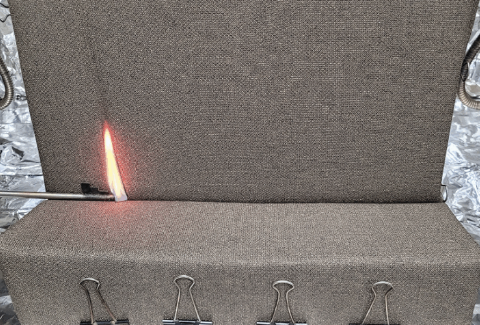
2. Ignition Sources: Source 0 to Source 7
The ignition sources are arranged in increasing severity. Source 0 is a smouldering cigarette. Sources 1, 2 and 3 use controlled butane flames. Sources 4, 5, 6 and 7 use flaming wooden cribs with increasing mass and thermal output.
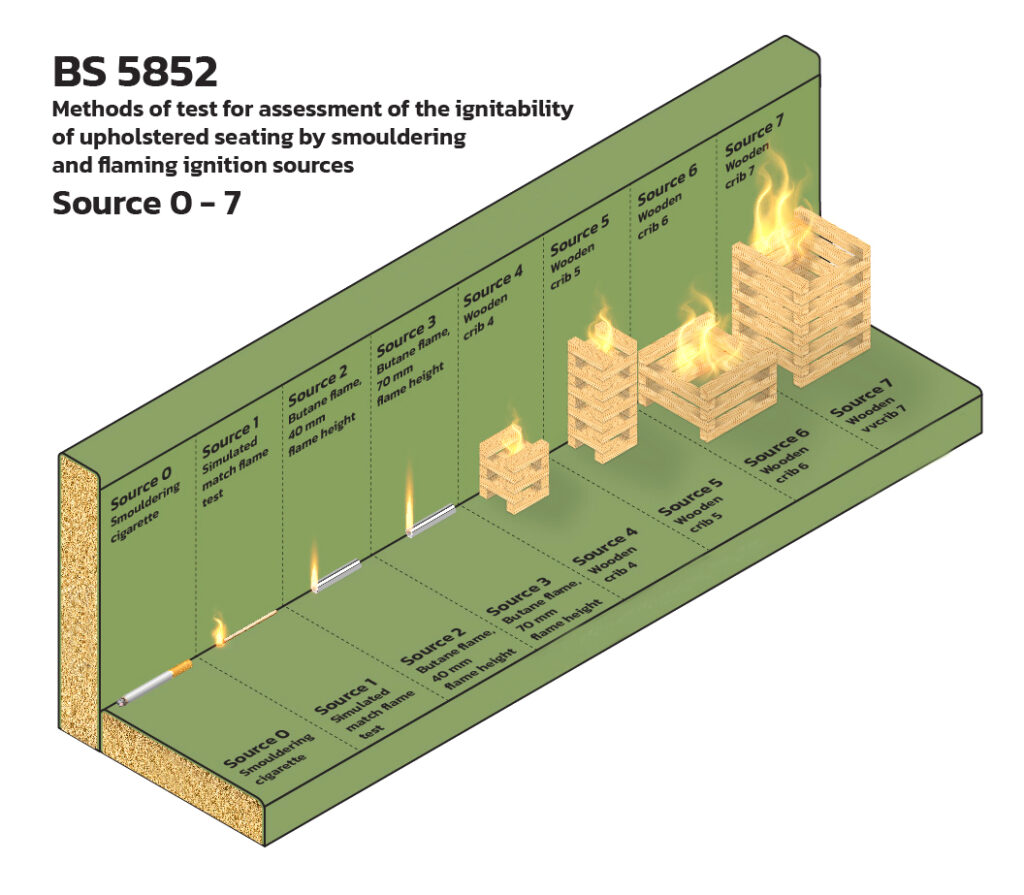
2.1 Source 0 – Smouldering cigarette
The source is an untipped cigarette. In the supplied 1990 edition the nominal requirements are 70 ±4 mm in length, 8 ±0.5 mm in diameter and 1 ±0.1 g in mass. The smouldering rate is checked over a 50 mm distance and is required to be 12 ±3 min. One cigarette from each batch of ten is used for this verification.
- Mark the cigarette at 5 mm and 55 mm from the end to be lit.
- Ignite it and draw air through it until the tip glows brightly; 5–8 mm is consumed during ignition.
- For the rate check, support the cigarette horizontally on a wire spike inserted no more than 13 mm into the unlit end.
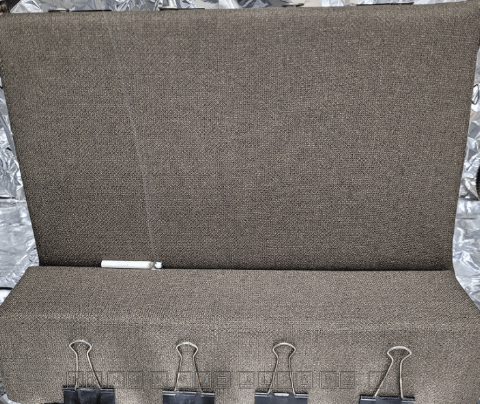
2.2 Sources 1–3 – Butane flames
| Source | Gas flow at 25 °C | Gas burn time | Approx. free flame height |
| 1 | 45 ±2 mL/min | 20 ±1 s | 35 mm |
| 2 | 160 ±5 mL/min | 40 ±1 s | 145 mm |
| 3 | 350 ±10 mL/min | 70 ±1 s | 240 mm |
The burner tube is stainless steel, 200 ±5 mm long, with an outside diameter of 8.0 ±0.1 mm and an internal diameter of 6.5 ±0.1 mm. It is supplied through a calibrated flowmeter, fine-control valve, optional on/off valve and a nominal 28 mbar regulator. The flexible tube between flowmeter and burner is 2.5–3.0 m long with an internal diameter of 7.0 ±1.0 mm.
The standard emphasizes accurate gas-flow setting. It describes a soap-bubble flowmeter and calibrated glass tube (for example, a burette) as one way to verify the absolute gas flow at the burner tube.
3. Wooden Crib Ignition Sources 4–7
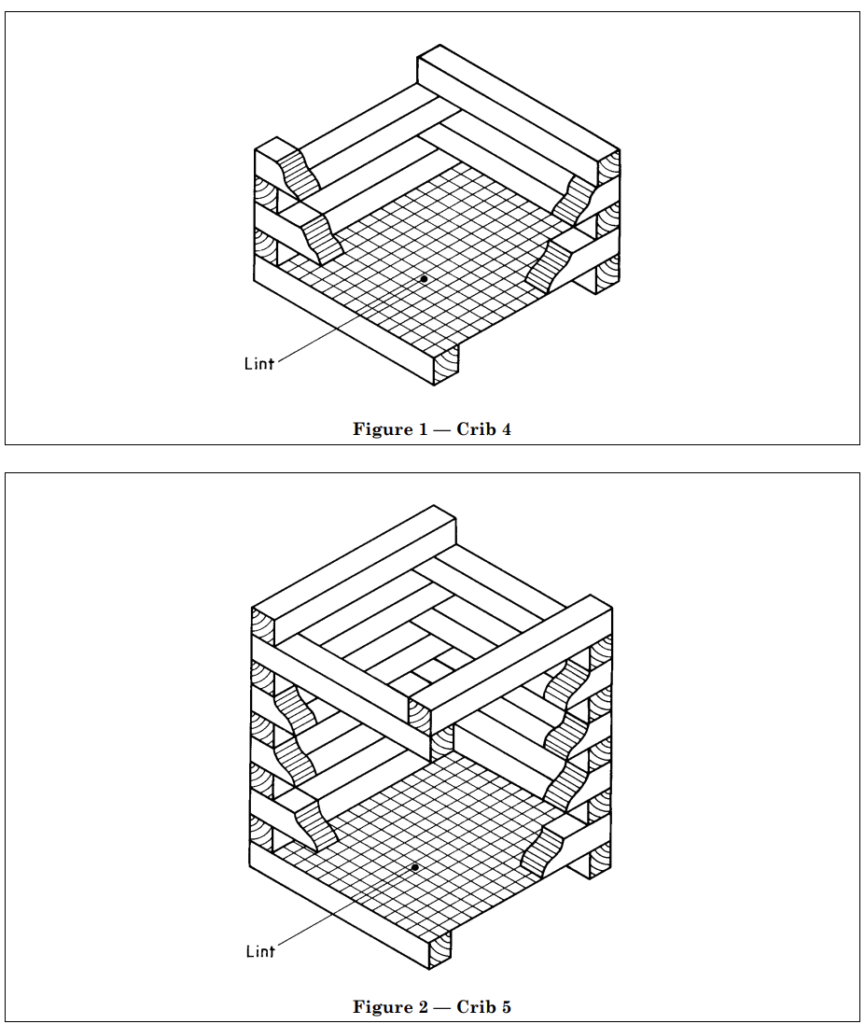
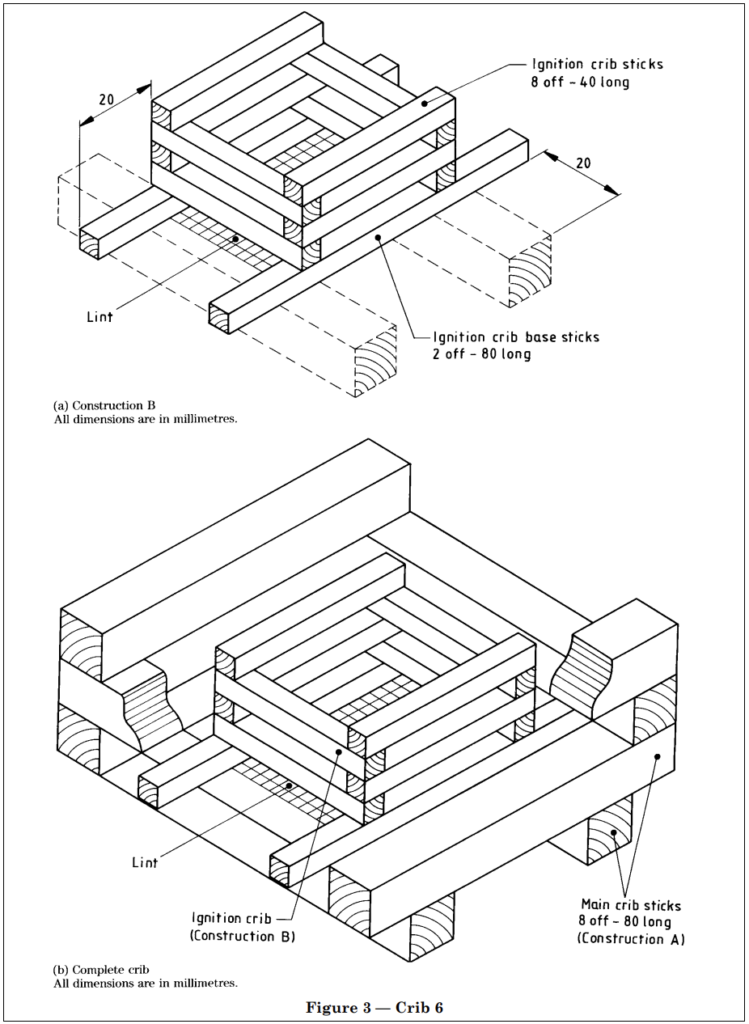
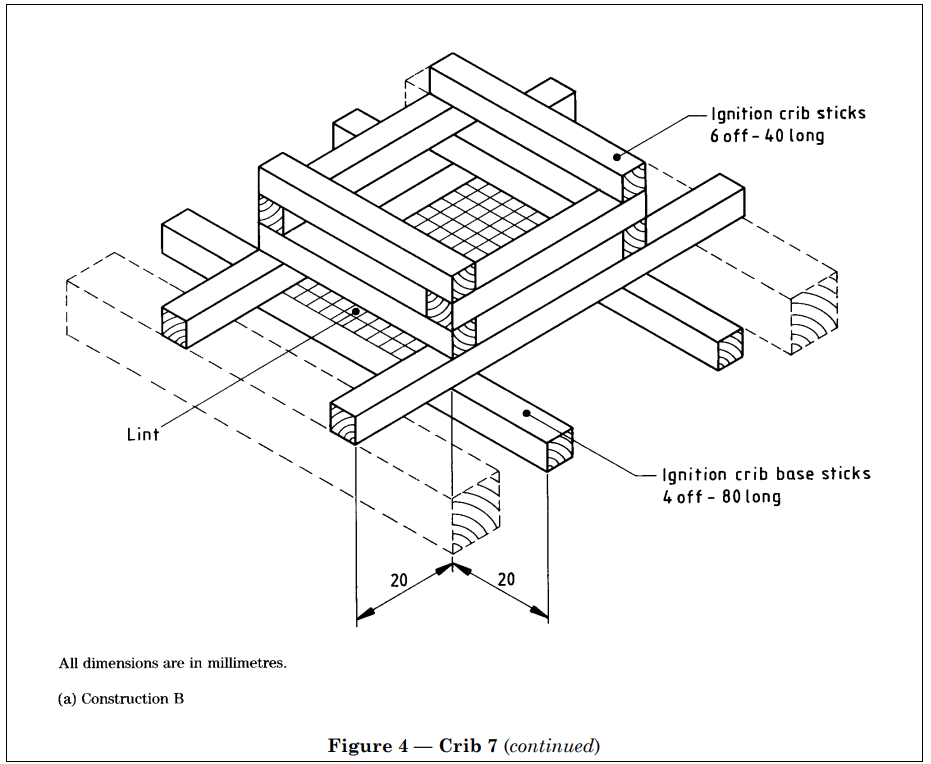
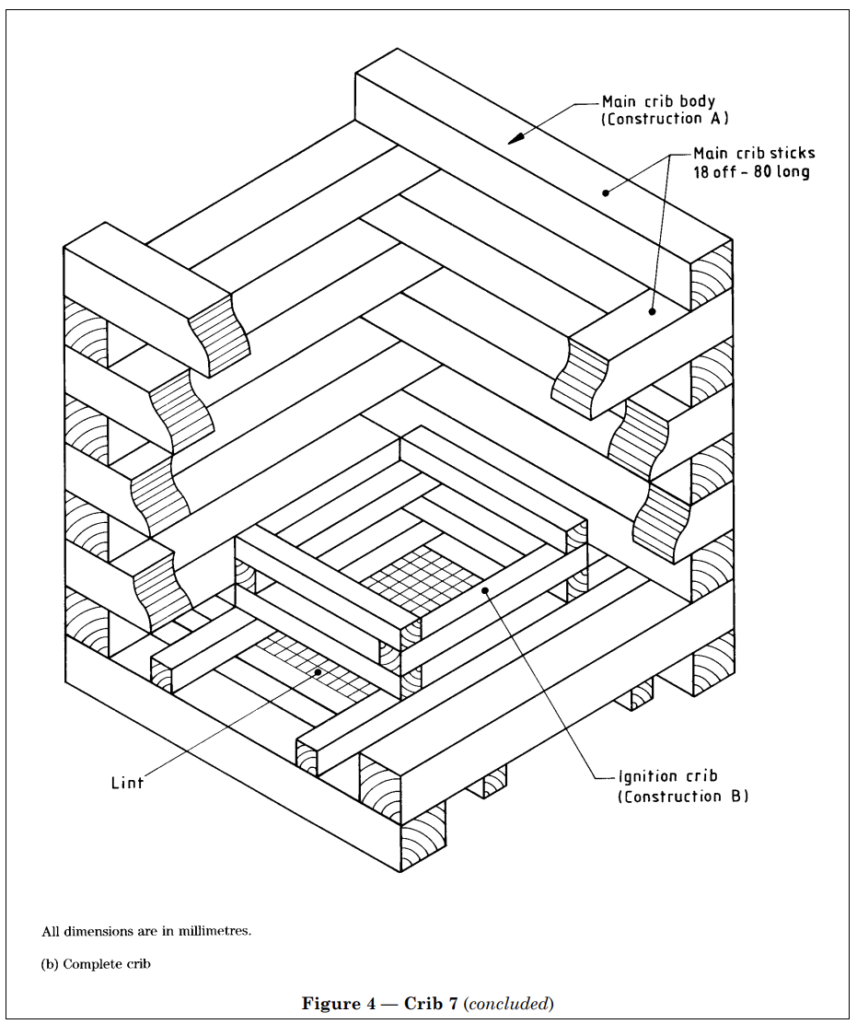
Sources 4–7 are wooden crib assemblies designed to provide progressively larger flaming ignition exposures and an additional mechanical load on the upholstery. They are not intended to reproduce burning newspaper in every detail.
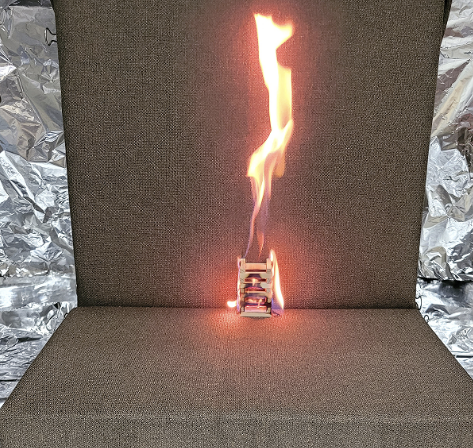
3.1 Materials
- Dry softwood Pinus silvestris (Scots pine), stored under warm, dry conditions for at least one week before use.
- BPC-grade absorbent surgical lint, approximately 200 g/m², cut into nominal 40 × 40 mm squares with a mass of approximately 0.3 g per square.
- Polyvinyl acetate (PVA) or another suitable wood adhesive.
3.2 Crib parameters
| Source | Principal stick section | Stick / assembly details | Total stick mass | Layers / form |
| 4 | 6.5 ±0.5 mm square; 40 ±2 mm long | 10 sticks | 8.5 ±0.5 g | 5 layers, 2 sticks/layer |
| 5 | 6.5 ±0.5 mm square; 40 ±2 mm long | 20 sticks | 17 ±1 g | 10 layers, 2 sticks/layer |
| 6 | Main: 12.5 ±0.5 mm square; 80 ±2 mm long | 8 main + ignition crib sticks | 60 ±2 g | Main crib plus inner ignition crib |
| 7 | Main: 12.5 ±0.5 mm square; 80 ±2 mm long | 18 main + ignition crib sticks | 126 ±4 g | Larger main crib plus inner ignition crib |
For assembly, adjacent layers are oriented at right angles to each other. The lint is incorporated with the fluffy side uppermost when the crib stands on its base. The standard gives suggested hardwood formers of about 27 × 27 × 100 mm for Cribs 4 and 5 and the inner cribs of Sources 6 and 7, and about 55 × 55 × 150 mm for Cribs 6 and 7.
Immediately before a crib test, 1.4 ±0.1 mL of propan-2-ol is added slowly to the centre of the lint. The alcohol is ignited within two minutes, and timing starts at ignition.
4. Conditioning and Test Environment
4.1 Conditioning
Test specimen materials are conditioned immediately before testing for 72 h in indoor ambient conditions and then for at least 16 h at 20 ±5 °C and 50 ±20% relative humidity. Cigarettes and wooden cribs are also conditioned as specified for their respective test methods.
4.2 Test atmosphere
| Parameter | Requirement / guidance |
| Temperature | 23 ±7 °C |
| Relative humidity | 45 ±25% RH |
| Local air velocity in enclosure | 0.02–0.2 m/s at the specimen position |
| Ventilation | Adequate oxygen without disturbing burning behaviour |
| Fume control | Smoke and toxic-gas extraction required |
| Testing must be carried out in a suitable fume cupboard or purpose-built room so that operators are not exposed to fumes. Suitable extinguishing means must be readily accessible. |
5. Section 4 – Upholstery Composite Testing
Section 4 evaluates the combined behaviour of cover material, interliner (if used) and filling. The standard deliberately models a horizontal/vertical junction because this is a critical geometry for accidental ignition of seating.
5.1 Test rig
- Two rectangular metal frames hinged together and capable of being locked at right angles.
- Vertical frame internal dimensions: 450 ±2 mm width × 450 ±2 mm height.
- Horizontal base frame internal dimensions: 450 ±2 mm width × 300 ±2 mm depth.
- Expanded steel supports the upholstery. A mesh around 28 × 6 mm across the diagonals is identified as suitable, although the mesh size itself is not inherently critical unless another specification requires it.
- A stop clock accurate to 1 s and capable of measuring at least 1 h is required.
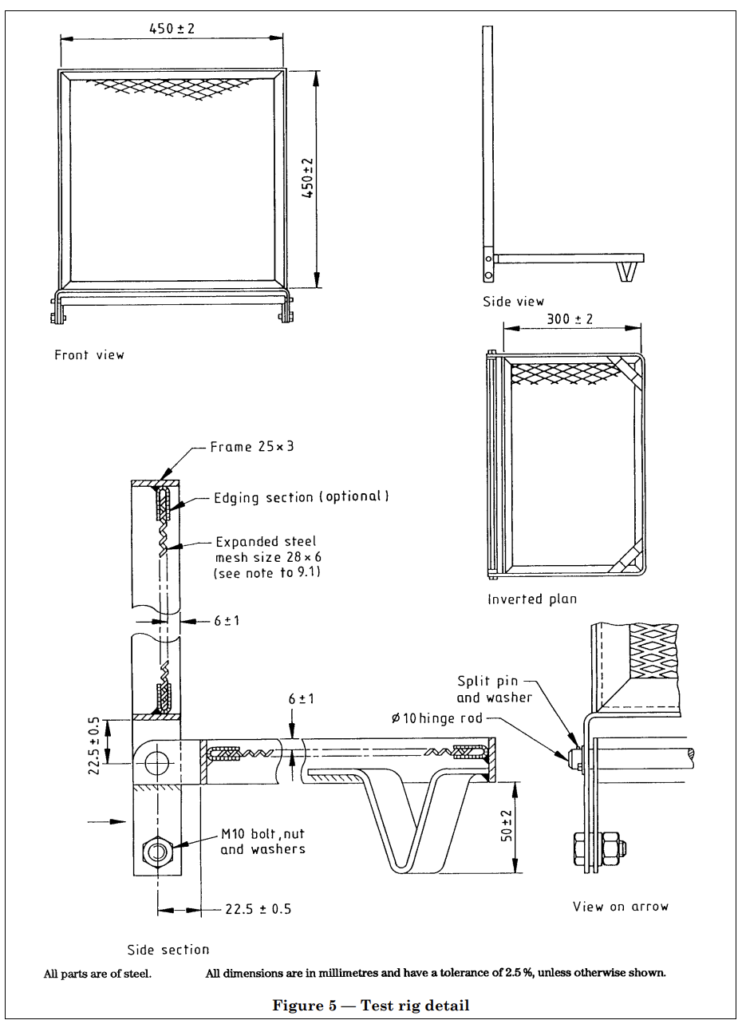
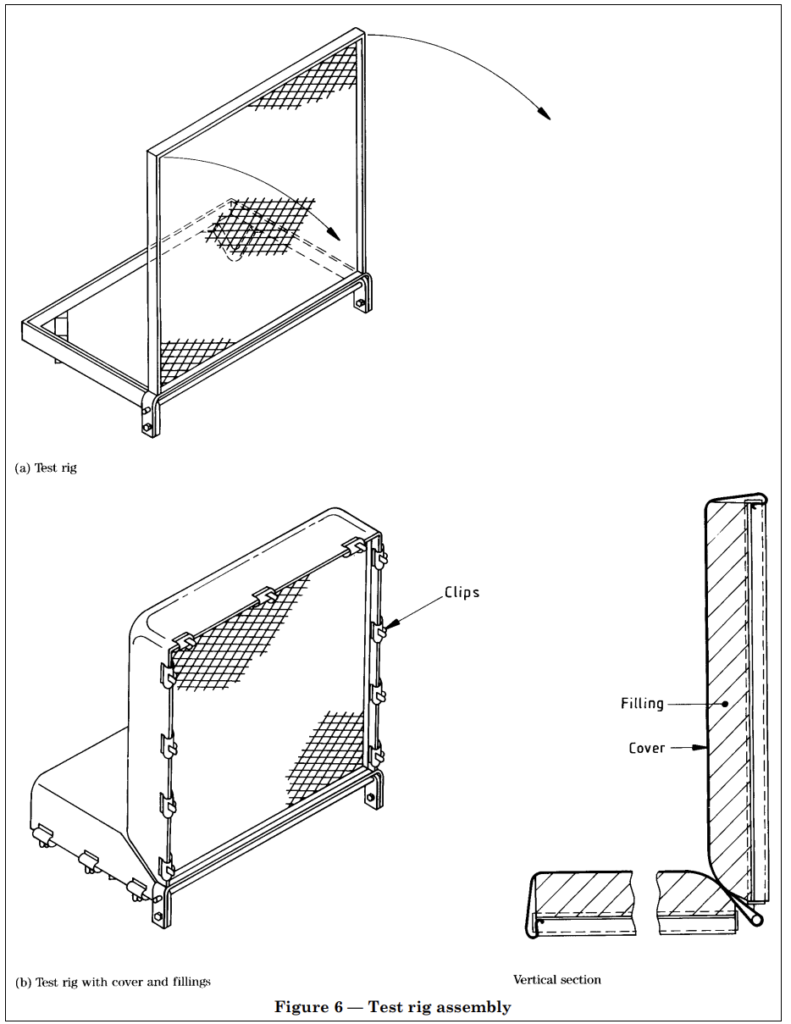
5.2 Test specimen construction
The specimen represents a single upholstery combination and comprises a vertical and a horizontal component. The filling represents the upper 75 mm of the intended upholstery construction. If a finished item uses different cover/filling combinations in the seat, back or arms, each combination is tested separately.
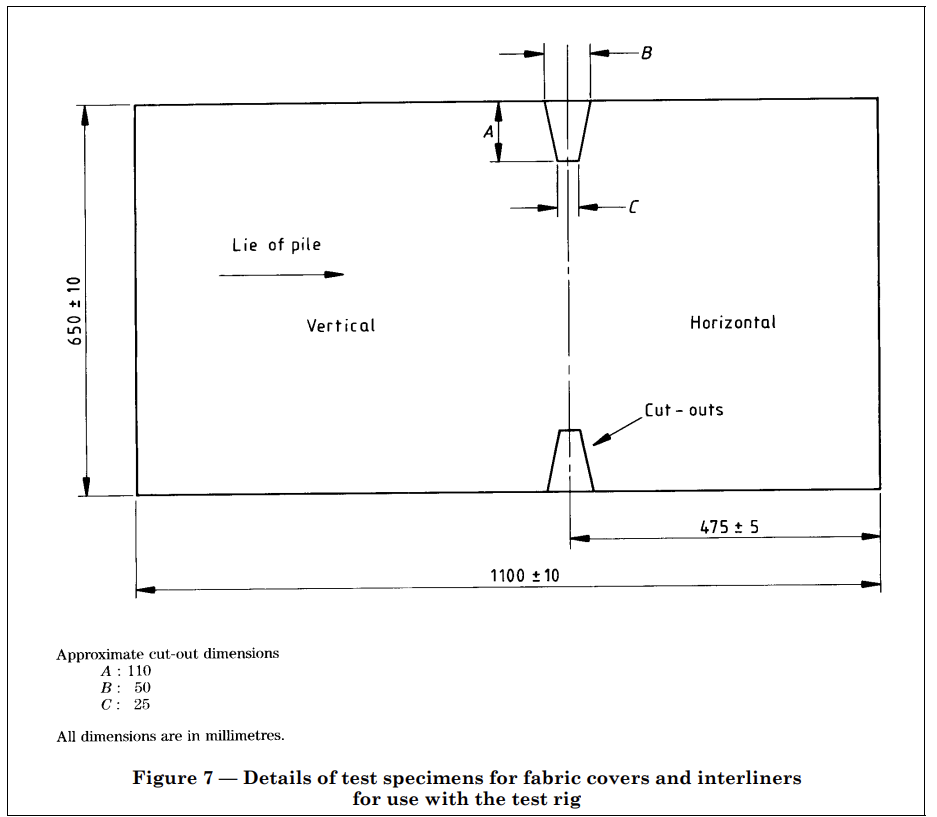
| Component | Dimensions | Notes |
| Vertical filling | 450 ±5 × 450 ±5 × 75 ±2 mm | Representative upper upholstery layers |
| Horizontal filling | 450 ±5 × 300 ±5 × 75 ±2 mm | Representative upper upholstery layers |
| Cover / interliner | Cut to Figure 7 pattern | Orientation and pile direction are controlled |
6. Section 4 Test Procedures
6.1 Butane sources 2 and 3
1. Light the butane at the burner and set the specified flow rate.
2. Allow the flame to stabilize for at least 2 min.
3. Position the burner axially along the junction between the vertical and horizontal parts of the specimen, at least 50 mm from an edge or previous damage.
4. Apply the source for the specified time, then remove the burner.
5. Observe the cover and interior for flaming and progressive smouldering.
6. If no ignition is observed, repeat at a fresh position; if the final examination reveals progressive smouldering, record ignition.
6.2 Wooden crib sources 4–7
1. Use a new specimen for each test.
2. After conditioning the crib, add 1.4 ±0.1 mL propan-2-ol to the centre of the lint.
3. Place the crib on the horizontal part, in contact with the vertical part and centrally between the sides of the rig.
4. Within 2 min, ignite the alcohol from the front and above the lint and start the clock simultaneously.
5. Observe for ignition in the cover and/or interior.
6. If no flaming or progressive smouldering is observed, repeat as specified. Perform a final internal examination of the filling.
| If a crib collapses and scatters embers more than 100 mm from the edge of the crib, the test is repeated using a new crib and a new specimen. |
7. Section 5 – Complete Item of Furniture
Section 5 evaluates an actual piece of seating furniture because design details can alter ignition performance in ways that cannot be represented by a simple composite test. The specimen is tested in its ready-for-use condition or, if different, its ready-for-sale condition, including loose covers, cushions and intended attachments.
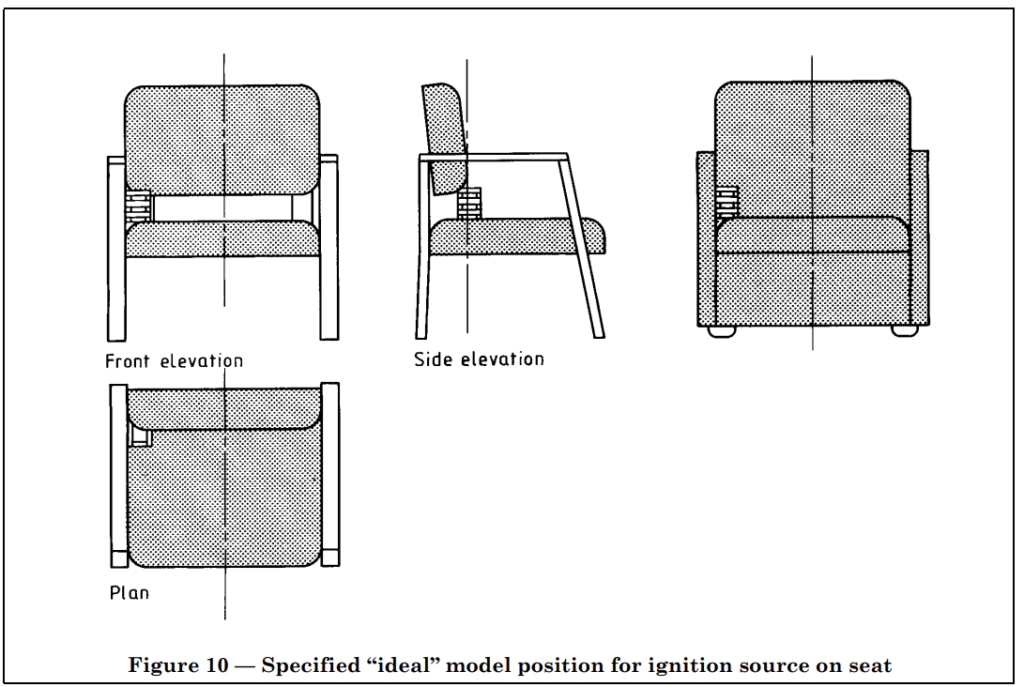
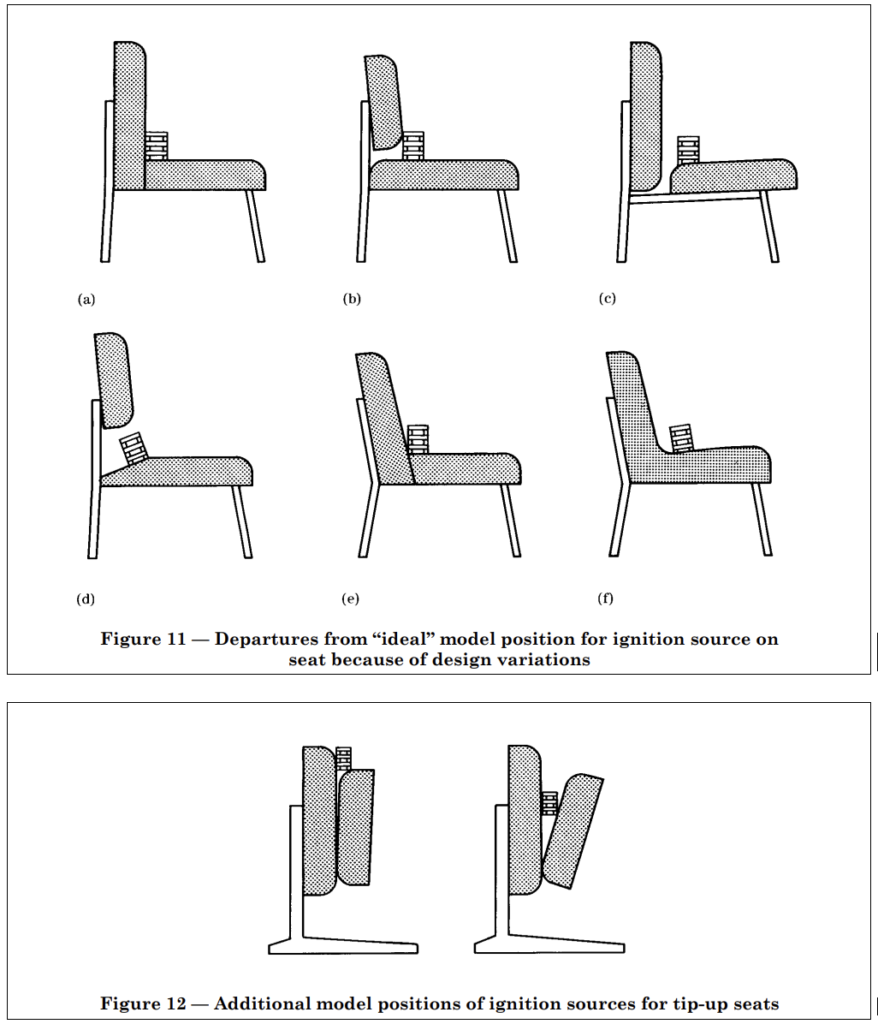
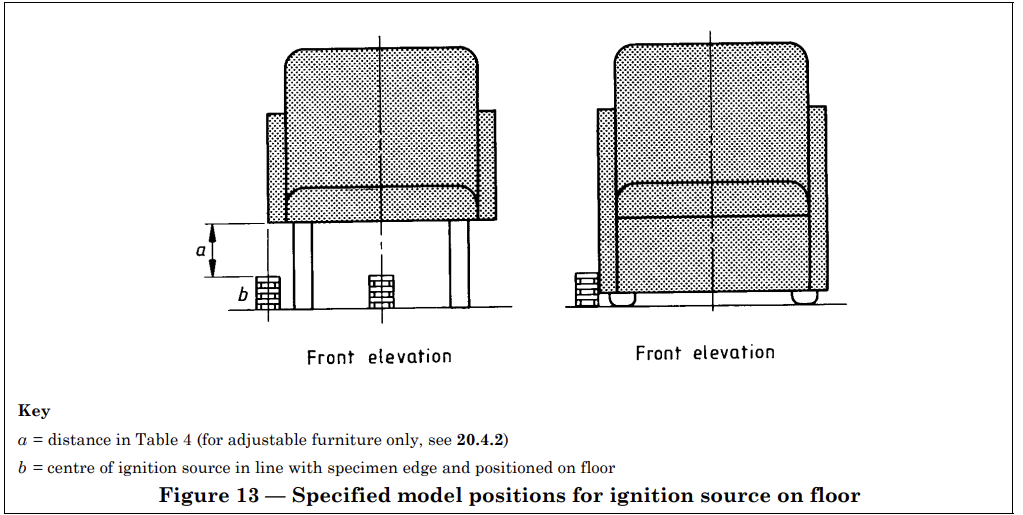
7.1 Selection of test zones
The tester selects the most vulnerable locations where an ignition source could reasonably rest. Where there is doubt, all potentially vulnerable positions are tested. The main categories are:
- Within the seating area, including grooves, recesses, seat/back junctions and seat/arm junctions.
- At floor level outside the seating area, adjacent to a vertical surface or beneath an overhang.
- At floor level underneath the specimen, where the clearance permits.
For complete-item testing, the test zone must be at least 0.5 m from the nearest enclosure wall. The enclosure and extinguishing system must be capable of dealing with the possibility of a fully developed furniture fire.
8. Complete-Item Source Application
8.1 Smouldering cigarette
The lighted cigarette is placed in the nominated zone without being pressed down. The specimen is observed for flaming or progressive smouldering. If no ignition is observed, or if the cigarette fails to smoulder its full length, a repeat is performed at a fresh position at least 50 mm from previous test damage.
8.2 Butane flame sources 1–3
The burner is set to the specified gas flow, allowed to stabilize for at least 2 min, then positioned horizontally at the nominated test zone. After the specified exposure time the burner is removed and the specimen is observed for ignition.
8.3 Wooden crib sources 4–7
A conditioned crib is dosed with 1.4 ±0.1 mL propan-2-ol, positioned at the nominated test zone, ignited within two minutes and observed. Flames or afterglow that cease within 10 min for Cribs 4 and 5 or within 13 min for Cribs 6 and 7 are considered in conjunction with the defined ignition criteria. Observation for progressive smouldering may continue for up to 60 min.
9. Ignition and Failure Criteria
BS 5852 treats progressive smouldering and flaming ignition as separate modes. A specimen may therefore fail even if it does not continue to show an obvious external flame.
9.1 Progressive smouldering
- Escalating smouldering that makes the test unsafe and requires forced extinction.
- Smouldering that essentially consumes the specimen or reaches its extremities within the test duration.
- For crib sources, externally detectable smoke, heat or glowing 60 min after ignition of the crib.
- On final examination, charring within the filling more than 100 mm in any direction (other than upwards) from the nearest part of the original source position.
9.2 Flaming ignition
- Escalating flaming combustion requiring forced extinction.
- The specimen burns until essentially consumed, or a flame front reaches specified extremities / passes through the full thickness.
- Sources 2 and 3: flaming continues for more than 120 s after burner removal.
- Sources 4 and 5: flaming continues for more than 10 min after crib ignition.
- Sources 6 and 7: flaming continues for more than 13 min after crib ignition.
| Final examination matters: the filling is dismantled and inspected because progressive smouldering can remain hidden inside the upholstery. |
10. Results and Test Report
In the 1990 edition, results are designated using “NI” for non-ignition and “I” for ignition, together with the relevant section and source number. For example, a composite passing Sources 2–6 but failing Source 7 is reported as Section 4 NI/2-6, I/7.
10.1 Information normally recorded
- Identification and construction of the test specimen, including any flame-retardant treatment.
- Conditioning and test conditions.
- Ignition source(s) applied and test position(s).
- Ignition / non-ignition result for each source.
- Details of ignition and notable burning behaviour, including melting, dripping, charring and development of flames from smouldering.
- Times of major events, such as ignition, cover splitting and extinction.
11. Safety Considerations
The standard warns that these tests involve considerable risk. The work should be carried out in a suitable fume cupboard or purpose-built room, with appropriate protective measures and ready access to extinguishing equipment.
| Hazard / need | Standard guidance |
| Smouldering specimens | Water is preferred for extinguishing smouldering fires. |
| Flaming specimens | Provide a suitable fire extinguisher. CO₂ extinguishers are stated as unsuitable for extinguishing the test specimens themselves. |
| Residual smouldering | Specimens may need to be immersed in water or placed in a sealed non-combustible enclosure until completely inert. |
| Complete furniture | Plan for rapid fire development and a fully developed fire; the enclosure and extinguishing system must have sufficient capacity. |
12. Practical Equipment Overview
| Subsystem | Typical equipment | Used for |
| Test enclosure | Fire-resistant room/chamber, extraction, controlled air inlet, temperature/RH/air-velocity monitoring | All tests |
| Composite rig | 90° hinged frames, expanded steel, fabric clips | Section 4 |
| Gas ignition | Butane cylinder, 28 mbar regulator, fine valve, flowmeter, hose, stainless burner | Sources 1–3 |
| Gas-flow verification | Soap-bubble flowmeter / calibrated glass tube or equivalent absolute flow check | Commissioning and periodic checks |
| Cigarette source | Specified untipped cigarettes, horizontal wire spike, timer | Source 0 |
| Wood crib preparation | Scots pine, lint, PVA, crib formers/jigs, balance, dimensional gauges | Sources 4–7 |
| Crib ignition | Propan-2-ol, graduated syringe capable of 1.4 ±0.1 mL, ignition source | Sources 4–7 |
| Safety | Water supply, suitable extinguisher, PPE, non-combustible disposal arrangement | All tests |
13. Relationship with Other Standards
The supplied 1990 edition states that it is used in conjunction with BS EN 1021-1 and BS EN 1021-2 for cigarette and match-flame-equivalent testing. It also draws attention to BS 7176, which applies ignition-resistance requirements to upholstered furniture in different hazard areas.
| Standard | Role | Relationship to BS 5852 |
| BS EN 1021-1 | Smouldering cigarette ignition test | Provides the cigarette-source method used alongside BS 5852 |
| BS EN 1021-2 | Match-flame-equivalent ignition test | Provides the low-level flaming-source method used alongside BS 5852 |
| BS 7176 | Performance specification for non-domestic upholstered seating | Uses test results / ignition-source levels to classify resistance appropriate to hazard categories |
| For design or conformity claims, use the current official editions of the relevant standards. This illustrated summary follows the supplied BS 5852:1990 document and should be treated as explanatory material only. |
14. Key Takeaways
- BS 5852 evaluates the ignitability of upholstery using a graded sequence of smouldering and flaming ignition sources.
- Composite tests and complete-furniture tests serve different purposes and should not be treated as interchangeable.
- Accurate source construction, gas flow, timing, conditioning and source placement are critical to reproducible results.
- Wooden Cribs 4–7 provide increasing flaming severity and require tightly controlled timber dimensions, mass and conditioning.
- Progressive smouldering can be hidden inside the filling, so final dismantling and examination are essential.
- A full test facility requires not only the rig and ignition sources, but also a suitable fire-test enclosure, extraction, environmental monitoring and extinguishing capability.
Master BOM
| Item No. | Component / Module | Qty. | Main Specification | Status | Reference |
|---|---|---|---|---|---|
| BS5852-001 | Main Fire Test Chamber / Enclosure | 1 | Suitable fire-test enclosure or purpose-built room | Mandatory | Clause 4.1 |
| BS5852-002 | Smoke & Toxic Gas Extraction System | 1 | Capable of extracting combustion fumes and toxic gases | Mandatory | Clauses 9.4 / 18.3 |
| BS5852-003 | Controlled Air Inlet System | 1 | Air velocity at specimen: 0.02–0.2 m/s | Mandatory | Clauses 9.4 / 18.3 |
| BS5852-004 | Fire-resistant Test Floor | 1 | Level, non-combustible test surface | Required for practical execution | Section 5 |
| BS5852-005 | Temperature Sensor / Thermometer | 1 | Suitable for monitoring 23 ±7°C | Required for compliance monitoring | Clause 9.4 |
| BS5852-006 | Relative Humidity Sensor | 1 | Suitable for monitoring 45 ±25% RH | Required for compliance monitoring | Clause 9.4 |
| BS5852-007 | Low-Velocity Air Meter | 1 | Measurement capability covering 0.02–0.2 m/s | Required for compliance monitoring | Clause 9.4 |
| BS5852-008 | Test Timer / Stop Clock | 1 | Resolution 1 s, capacity at least 1 h | Mandatory | Clauses 9.2 / 18.1 |
| BS5852-009 | Emergency Extinguishing System | 1 set | Water provision for smouldering fires + suitable extinguisher for flaming fires | Mandatory | Clause 4.2 |
| BS5852-010 | Heat-resistant Disposal Container | 1 | Non-combustible container for residual smouldering specimens | Recommended | Clause 4.2 guidance |
Upholstery Composite Test Rig
| Item No. | Component / Module | Qty. | Main Specification | Status |
|---|---|---|---|---|
| BS5852-020 | Vertical Test Frame | 1 | Internal dimensions 450 ±2 mm × 450 ±2 mm | Mandatory |
| BS5852-021 | Horizontal Test Frame | 1 | Internal dimensions 450 ±2 mm × 300 ±2 mm | Mandatory |
| BS5852-022 | Expanded Steel Platform — Vertical | 1 | Expanded steel; approximately 28 × 6 mm mesh suitable | Standard guidance |
| BS5852-023 | Expanded Steel Platform — Horizontal | 1 | Same as above | Standard guidance |
| BS5852-024 | Main Pivot / Hinge Assembly | 1 set | Connects vertical and horizontal frames | Mandatory |
| BS5852-025 | 90° Frame Locking Mechanism | 2 sets | Locks rig securely at right angles | Mandatory |
| BS5852-026 | Rear Support Legs | 2 | Supports vertical frame | Required by rig design |
| BS5852-027 | Fabric Retaining Clips | Set | Maintain even fabric tension around frame | Required for test preparation |
| BS5852-028 | Removable Hinge / Pivot Bar | 1 | Preferably removable for cleaning | Recommended |
| BS5852-029 | Rig Base / Support Structure | 1 | Stable, heat-resistant construction | Recommended |
Butane Ignition System — Sources 1, 2 and 3
| Item No. | Component | Qty. | Specification | Status |
|---|---|---|---|---|
| BS5852-040 | Butane Gas Cylinder | 1 | Suitable commercial butane supply | Mandatory |
| BS5852-041 | Cylinder Pressure Regulator | 1 | Nominal outlet pressure 28 mbar | Mandatory |
| BS5852-042 | Gas On/Off Valve | 1 | Manual shut-off | Optional in standard, recommended |
| BS5852-043 | Fine Control Valve | 1 | Fine adjustment of gas flow | Mandatory |
| BS5852-044 | Butane Flowmeter | 1 | Must cover required source flow rates | Mandatory |
| BS5852-045 | Flexible Gas Tubing | 1 | 2.5–3.0 m, ID 7.0 ±1.0 mm | Mandatory |
| BS5852-046 | Stainless Steel Burner Tube | 1 | OD 8.0 ±0.1 mm | Mandatory |
| BS5852-047 | Burner Internal Bore | — | ID 6.5 ±0.1 mm | Mandatory |
| BS5852-048 | Burner Tube Length | — | 200 ±5 mm | Mandatory |
| BS5852-049 | Burner Positioning Fixture | 1 | Adjustable positioning holder | Recommended |
| BS5852-050 | Quick Burner Retraction Mechanism | 1 | Rapid repeatable removal after flame duration | Recommended |
| BS5852-051 | Gas Pressure Gauge | 1 | For regulator/output monitoring | Recommended |
| BS5852-052 | Flame Shield / Pilot Igniter | 1 | Safe burner ignition | Recommended |
The specified burner is a stainless-steel tube with OD 8.0 ±0.1 mm, ID 6.5 ±0.1 mm, length 200 ±5 mm, connected through a flowmeter, fine control valve and regulator to the butane source.
The system must be capable of producing the following nominal test conditions:
| Source | Butane Flow at 25°C | Burn Time |
|---|---|---|
| Source 1 | 45 ±2 ml/min | 20 ±1 s |
| Source 2 | 160 ±5 ml/min | 40 ±1 s |
| Source 3 | 350 ±10 ml/min | 70 ±1 s |
Flowmeter Verification / Calibration Kit
| Item No. | Component | Qty. | Specification | Status |
|---|---|---|---|---|
| BS5852-060 | Soap Bubble Flowmeter | 1 | Suitable for absolute gas-flow verification | Standard suggested method |
| BS5852-061 | Calibrated Glass Tube / Burette | 1 | Known calibrated volume | Suggested |
| BS5852-062 | Short Calibration Hose | 1 | Approx. 7 mm ID | Suggested |
| BS5852-063 | Calibration Timer | 1 | Can share main timer | Suggested |
| BS5852-064 | Bubble Solution Reservoir | 1 | Suitable soap-film generation arrangement | Recommended |
This is a verification method suggested by the standard for checking the actual gas flow at the burner outlet.
Source 0 — Smouldering Cigarette Equipment
| Item No. | Component | Qty. | Specification | Status |
|---|---|---|---|---|
| BS5852-070 | Standard Untipped Cigarettes | Consumable | Length 70 ±4 mm | Mandatory source |
| BS5852-071 | Cigarette Diameter | — | 8 ±0.5 mm | Mandatory characteristic |
| BS5852-072 | Cigarette Mass | — | 1 ±0.1 g | Mandatory characteristic |
| BS5852-073 | Horizontal Wire Spike Holder | 1 | Spike inserted max 13 mm into unlit end | Required |
| BS5852-074 | Cigarette Marking Gauge | 1 | Marks at 5 mm and 55 mm | Recommended |
| BS5852-075 | Cigarette Smouldering Timing Fixture | 1 | For 50 mm smouldering-rate check | Required |
| BS5852-076 | Cigarette Ignition Device | 1 | Suitable lighter / flame source | Required |
The specified cigarette has a nominal length of 70 ±4 mm, diameter 8 ±0.5 mm, mass 1 ±0.1 g, and a required smouldering rate of 12 ±3 min over 50 mm.
Wooden Crib System — Sources 4, 5, 6 and 7
| Item No. | Component | Qty. | Specification | Status |
|---|---|---|---|---|
| BS5852-080 | Scots Pine Timber | Consumable | Pinus silvestris, dry conditioned timber | Mandatory |
| BS5852-081 | Surgical Absorbent Lint | Consumable | Approx. 200 g/m² | Mandatory |
| BS5852-082 | Lint Cutter / Template | 1 | Nominal 40 × 40 mm squares | Recommended |
| BS5852-083 | PVA Wood Adhesive | Consumable | PVA or suitable alternative | Mandatory |
| BS5852-084 | Crib 4 Assembly Jig | 1 | Suitable for Source 4 geometry | Recommended |
| BS5852-085 | Crib 5 Assembly Jig | 1 | Suitable for Source 5 geometry | Recommended |
| BS5852-086 | Crib 6 Assembly Jig | 1 | Suitable for Source 6 geometry | Recommended |
| BS5852-087 | Crib 7 Assembly Jig | 1 | Suitable for Source 7 geometry | Recommended |
| BS5852-088 | Small Hardwood Former | 1 | Approx. 27 ×27 ×100 mm | Standard suggested |
| BS5852-089 | Large Hardwood Former | 1 | Approx. 55 ×55 ×150 mm | Standard suggested |
| BS5852-090 | Precision Balance | 1 | Suitable for sub-gram to ~150 g crib checks | Required in practice |
| BS5852-091 | Vernier Caliper | 1 | For checking stick section and length | Required in practice |
| BS5852-092 | Go / No-Go Gauge Set | 1 set | For timber cross-section verification | Recommended |
| BS5852-093 | Timber Cutting Jig / Saw | 1 | Repeatable crib stick cutting | Recommended |
For crib construction, the standard specifies dry Scots pine, absorbent surgical lint approximately 200 g/m², lint squares nominally 40 ×40 mm, and PVA or another suitable wood adhesive.
The standard also suggests using a 27 ×27 ×100 mm hardwood former for Cribs 4 and 5 and the inner cribs of 6 and 7, plus a 55 ×55 ×150 mm former for Cribs 6 and 7.
Crib 4–7 Consumable Specifications
| Source | Main Requirements |
|---|---|
| Crib 4 | 40 ±2 mm sticks, 6.5 ±0.5 mm square, 10 sticks, total 8.5 ±0.5 g |
| Crib 5 | 40 ±2 mm sticks, 6.5 ±0.5 mm square, 20 sticks, total 17 ±1 g |
| Crib 6 | Main sticks 80 ±2 mm, 12.5 ±0.5 mm square; total crib mass 60 ±2 g |
| Crib 7 | Main sticks 80 ±2 mm, 12.5 ±0.5 mm square; total crib mass 126 ±4 g |
The exact numbers of main and ignition-crib sticks are defined in Tables 2 and 3 of the standard.
Crib Ignition / Liquid Dosing Equipment
| Item No. | Component | Qty. | Specification | Status |
|---|---|---|---|---|
| BS5852-100 | Propan-2-ol | Consumable | Test-grade suitable material | Mandatory |
| BS5852-101 | Graduated Glass Syringe | 1 | Capable of measuring 1.4 ±0.1 mL | Mandatory |
| BS5852-102 | Small Ignition Flame / Hot Wire | 1 | For ignition of alcohol-loaded lint | Required |
| BS5852-103 | Propan-2-ol Storage Bottle | 1 | Suitable safety container | Recommended |
| BS5852-104 | Dosing Stand | 1 | Repeatable controlled dosing | Recommended |
The apparatus requirement explicitly includes propan-2-ol and a graduated syringe or equivalent instrument capable of measuring 1.4 ±0.1 mL.
Conditioning Equipment
| Item No. | Component | Qty. | Specification | Status |
|---|---|---|---|---|
| BS5852-110 | Conditioning Chamber / Room | 1 | 20 ±5°C, 50 ±20% RH | Required |
| BS5852-111 | Conditioning Timer / Logger | 1 | Track conditioning duration | Recommended |
| BS5852-112 | Temperature Data Logger | 1 | Conditioning verification | Recommended |
| BS5852-113 | RH Data Logger | 1 | Conditioning verification | Recommended |
| BS5852-114 | Sample Storage Racks | Set | Air circulation around samples | Recommended |
| BS5852-115 | Crib Conditioning Tray | Set | Clean, dry storage for wooden cribs | Recommended |
| BS5852-116 | Cigarette Conditioning Container | 1 | Suitable controlled storage | Recommended |
Test materials must be conditioned for 72 h in indoor ambient conditions, followed by at least 16 h at 20 ±5°C and 50 ±20% RH.
Complete Furniture Test — Section 5 Accessories
| Item No. | Component | Qty. | Specification | Status |
|---|---|---|---|---|
| BS5852-120 | Furniture Test Platform | 1 | Flat surface representing floor level | Required |
| BS5852-121 | Movable Specimen Positioning Platform | 1 | Suitable for chairs / sofas / seating units | Recommended |
| BS5852-122 | Position Measurement Scale | 1 set | For ignition-source positioning | Recommended |
| BS5852-123 | 0.5 m Clearance Marking System | 1 | Verify test-zone distance from chamber wall | Recommended |
| BS5852-124 | Under-Furniture Burner Holder | 1 | Allows Source 1–3 positioning underneath specimen | Recommended |
| BS5852-125 | Peripheral Ignition Holder | 1 | For floor-level side/front/rear ignition positions | Recommended |
| BS5852-126 | Crib Positioning Tray / Locator | 1 | Stable crib placement | Recommended |
| BS5852-127 | Adjustable Source Spacer Set | 1 set | Useful for controlled source-to-specimen positioning | Recommended |
For complete furniture tests, the enclosure must permit the test zone to be located at least 0.5 m from the nearest enclosure wall, and the test source may be positioned in the seating area, at floor level beside the furniture, or underneath it.
Safety Equipment
| Item No. | Component | Qty. | Status |
|---|---|---|---|
| BS5852-130 | Water Supply / Hose | 1 | Required / preferred for smouldering |
| BS5852-131 | Suitable Fire Extinguisher | 1+ | Mandatory |
| BS5852-132 | Fire Blanket | 1 | Recommended |
| BS5852-133 | Emergency Stop | 1 | Recommended |
| BS5852-134 | Gas Solenoid Safety Valve | 1 | Recommended |
| BS5852-135 | Gas Leak Detector | 1 | Recommended |
| BS5852-136 | Combustible Gas Detector | 1 | Recommended |
| BS5852-137 | High Temperature Alarm | 1 | Recommended |
| BS5852-138 | Extraction Failure Interlock | 1 | Recommended |
| BS5852-139 | PPE Set | Set | Depending on risk assessment |
| BS5852-140 | Respiratory Protection | Set | Depending on installation/risk assessment |
For complete furniture testing, the standard specifically warns that a fully developed fire can occur, so the enclosure and extinguishing arrangement must be capable of dealing with that situation.
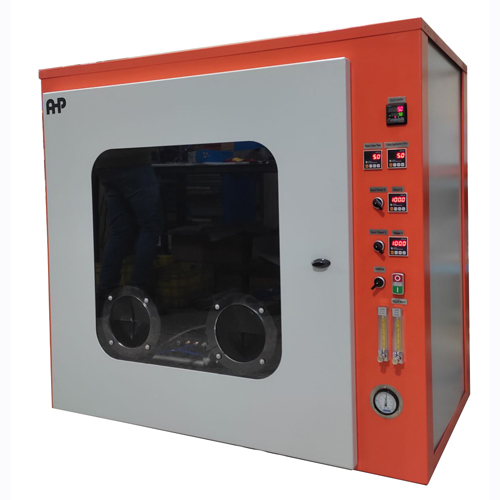
Flame Test Chamber According to BS 5852 Clause 11, Ignition source 1, 2 & 3 | EN 1021-2
- Specimen type: Upholstered furniture
- Test standards: BS 5852 Clause 11, ignition source 1, 2 & 3EN 1021-2
- Gas type is Butane
- Combustion chamber
- Mechanical flow controller and burner
- Gas flow controller
- Hoses and burner
- Test rig according to figure 6
- Digital timer included
- To be provided by the customer
Test room > 20 m3
Flue gas extraction system
Gas balloon and pressure regulator for gas - Manual needle valve for gas flow control
- Solenoid valve and flame protection is as option, operator need to be with machine during flame application period to check the flame