

Schedule B—Warehouse Stacking and Schedule
C—Vehicle Stacking:
11.1 The test levels and the test methods for these schedules of a distribution cycle are intended to determine the ability of the shipping unit to withstand the compressive loads that occur during warehouse storage or vehicle transport. The required loading must consider the effects of length of time in storage, the alignment or stacking pattern of the container, variability in container strength, moisture content, temperature, previous handling and transportation, method of load support, and vibration. The minimum required loads for typical shipping units which include the combined effects of the above factors are recommended below for Schedule B—Warehouse Stacking and Schedule C—Vehicle Stacking (select test levels for either warehouse or vehicle stacking as defined in the distribution cycle):
Test Method D642.
Conditioning—73.4 6 2°F (23 6 1°C), 50 6 2 % relative humidity in accordance with Practice D4332.
11.2 Use the following test levels:
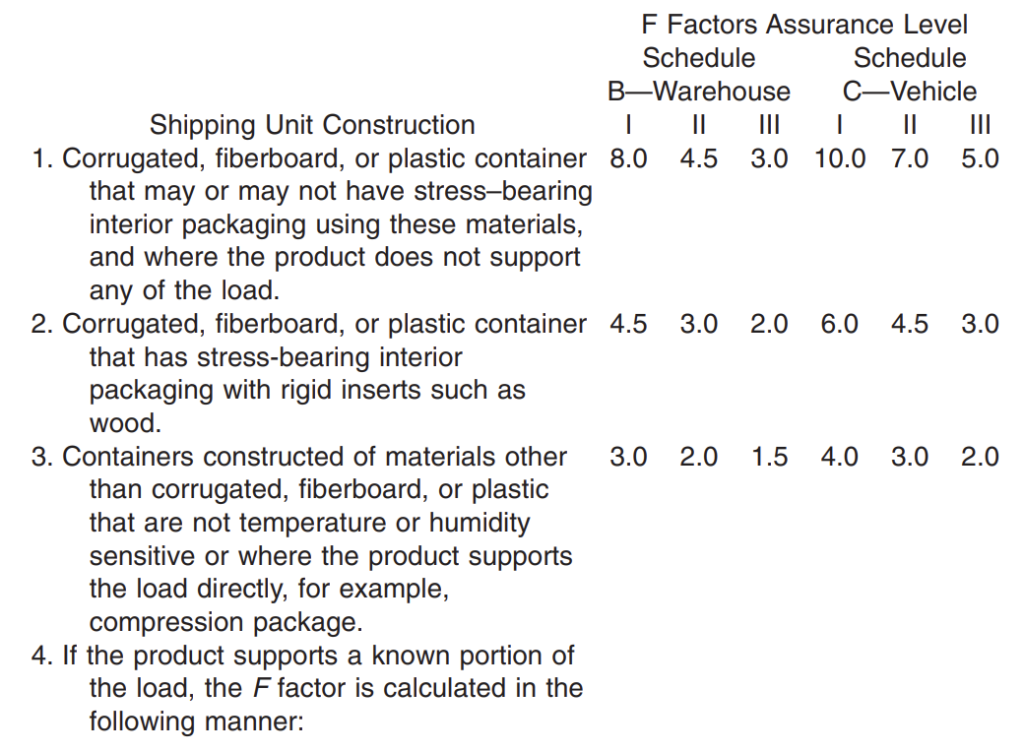
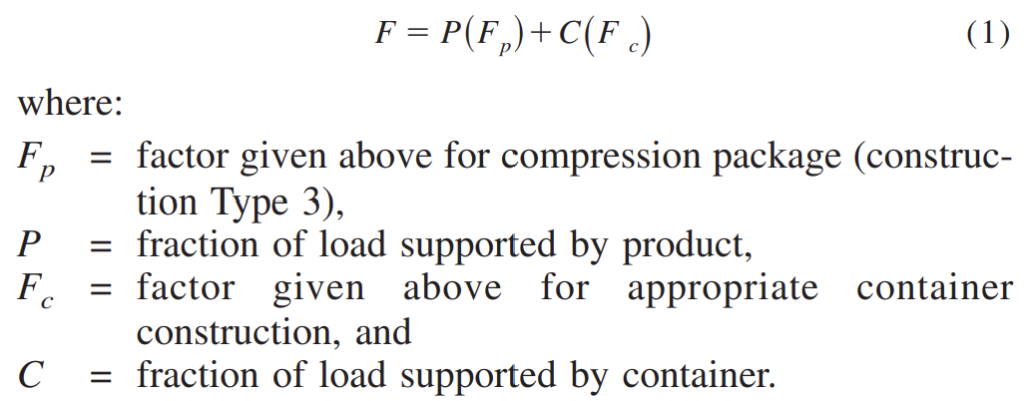
If a full pallet load is tested, F factors may be reduced by 30 %.
11.3 For warehouse stacking and vehicle stacking made up of identical shipping units, load the shipping unit to the computed load value, as calculated below. Remove the load within 3 s after reaching the specified value.

where:
L = computed load, lbf or N,
M = mass of one shipping unit or individual container, lb or kg,
J = 1 lbf/lb or 9.8 N/kg,
H = maximum height of stack in storage or transit vehicle (if vehicle stack height is unknown, use 108 in.(2.7 m)), in. or m,
h = height of shipping unit or individual container, in. or m, and
F = a factor to account for the combined effect of the individual factors described above.
11.4 For vehicle stacking made up of mixed commodities and shipped in an LTL or small package delivery environment, load the shipping unit to the computed load value, as calculated below. Remove the load within 3 s after reaching the specified value. If the average shipping density factor (Mf ) for the specific distribution system is not known, use a value of 10lb/ft3 (160 kg/m3 ).

where:
L = computed load, lbf or N,
Mf = shipping density factor, lb/ft3 or kg/m3,
J = 1 lbf/lb or 9.8 N/kg,
H = maximum height of stack in transit vehicle (if vehicle stack height is unknown, use 108 in.(2.7 m)), in. or m, see Note 3,
h = height of shipping unit or individual container, in. or m,
l = length of shipping unit or individual container, in. or m,
w = width of shipping unit or individual container, in. or m,
K = 1728 in.3 /ft3 or 1 m3 /m3 , and
F = a factor to account for the combined effect of the individual factors described above.
NOTE 3—The value for H, when unknown, is reduced to 54 in. (1.4 m) from 108 in. (2.7 m) for packages under 30 lb (13.6 kg) and 2.0 ft3 (0.056 m3 ) or less in size when applied to a vehicle stacking hazard element in LTL shipments.
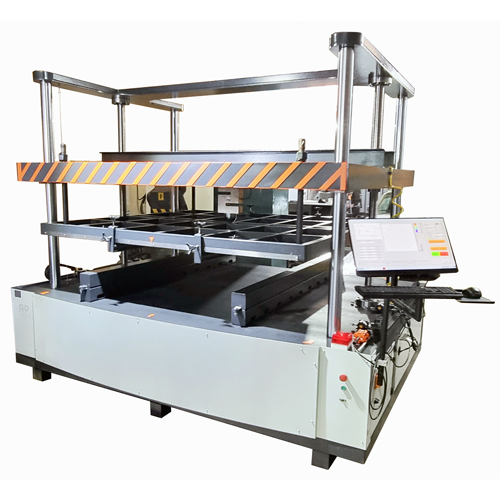
Compression Tester of Pallets and Shipping Containers
- According to ASTM D4169, ISO 8611
- It includes two types of 2 column and 4 column compression machine
- Computer controlled
- Windows based software
- Full test cycle of pallets at the touch of a button
- Displacement measurement in 5 points
- Report in MS EXCEL
- Portable displacement measurement device
- In different capacities of 50KN-10KN-15KN-200KN-250KN-300KN
- Hard chrome guide shafts
- USB data out
- Servomotor controlled
- Size of compression plates and travel distance according to customer request