

8 Performance Requirements
8.1 The following performance requirements shall be met by Type I and Type II tanks:
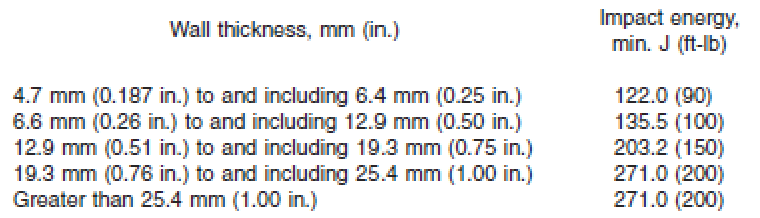
8.1.1 Low-Temperature Impact—Low-temperature impact
shall be determined using the test method described in 11.3. The requirements for Type I and Type II tanks are as follows:
11 Test Methods
11.1 Test Specimens—Test specimens shall be taken from an area that is representative of the bottom side wall. If no representative sample cut-out area in the tank is available, test specimens shall be molded in a test mold. In either case, prior testing shall verify that the tank wall and the test specimen have equal impact resistance.
11.1.1 The test mold shall be constructed of the same type material and have the same wall thickness as the tank mold. The thickness of the specimen from a test mold shall be the same as the thickness of the bottom sidewall within the tolerances as defined in 9.1.2. The test mold shall be molded with each tank.
11.2 Conditioning—If requested, test specimens shall be conditioned at 23 ± 2°C (73.4 ± 3.6°F) and 50 ± 5 % relative humidity for not less than 40 h prior to testing in accordance with Procedure A of Practice D618.
11.3 Low-Temperature Impact Test:
11.3.1 Scope—This test method is for the determination of the impact property of rotational-molded polyethylene tanks at low temperature. The test method is used on tanks molded from both crosslinked and non-crosslinked polyethylenes.
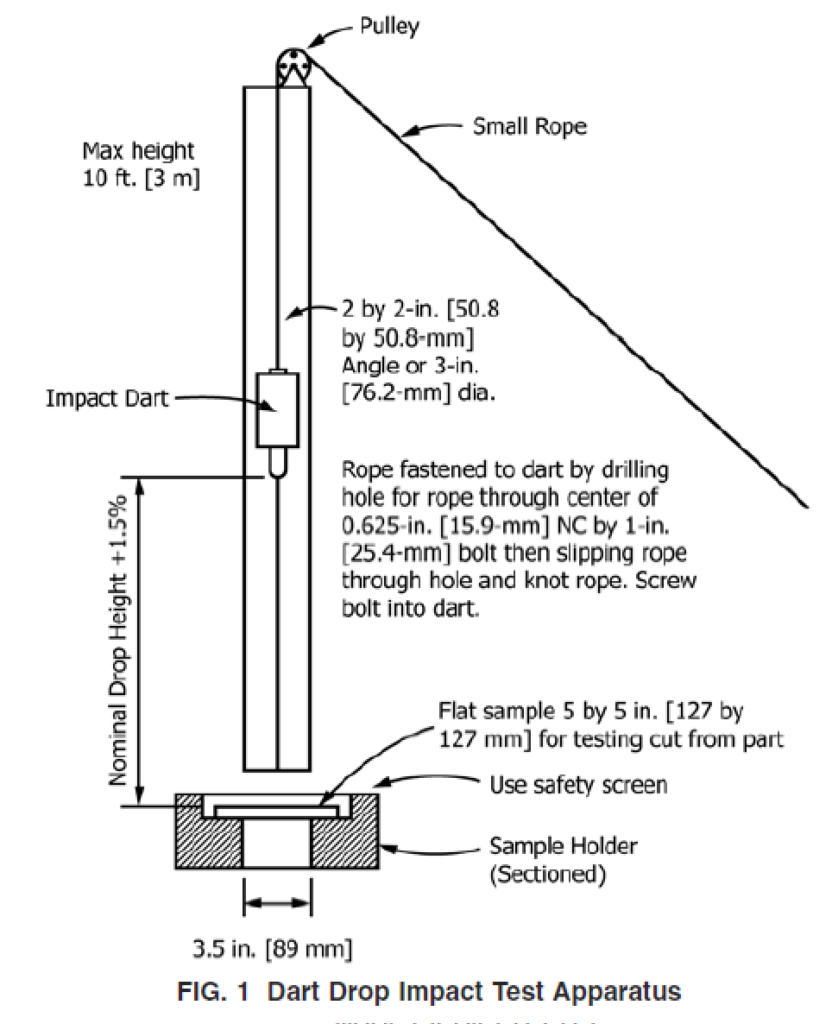
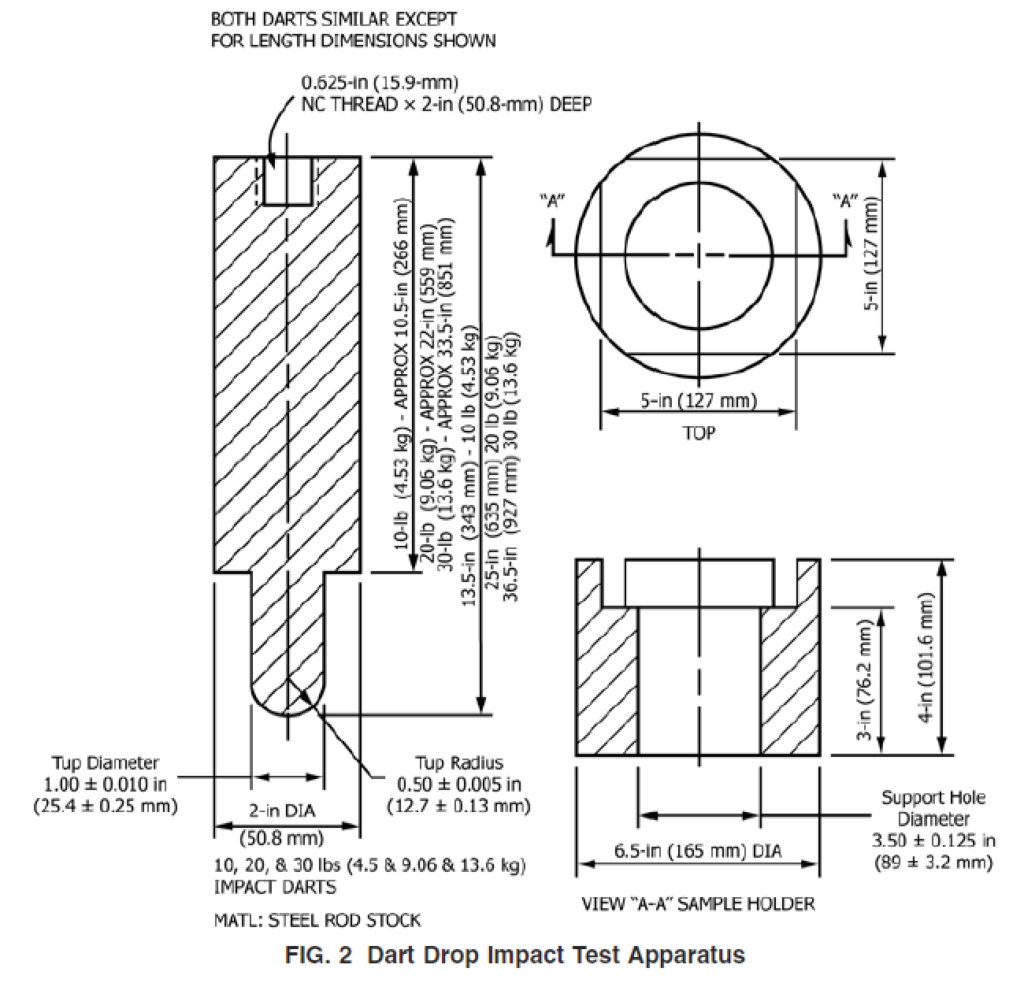
11.3.2 Summary of Test Method—Test specimens are cut from available areas on the tank and conditioned at − 29°C (−20°F) for a specified time. A suitable type of test apparatus is shown in Fig. 1 and Fig. 2. The specimens are placed, inside-surface down, in the sample holder and immediately impacted from a prescribed height with a dart of specified weight and tip radius. The specimen is observed for failure on both surfaces. The test prescribes a minimum impact value that the specimen must pass.
11.3.3 Significance and Use:
11.3.3.1 The dart impact test at −29°C (−20°F) produces a value that is used as an indication of the quality of the tank. If the molding conditions were inadequate and a homogenous melt was not obtained, the impact will likely be low. Higher impact values are obtained with ideal molding conditions indicating that a quality part with good impact resistance has been molded.
11.3.3.2 The impact test gives a true indication of how well the tank was molded.
11.3.4 Procedure:
11.3.4.1 Cut specimens to loosely fit the 127 mm by 127 mm (5 in. by 5 in.) sample holder (See Fig. 2). Specimens shall be approximately 127 mm by 127 mm (5 in. by 5 in.), or the maximum size available. In those tanks where specimens of the above size are not available, the supplier must show correlation data between the smaller size and the recommended size.
11.3.4.2 Cool bath to − 29°C (−20°F) by immersing small quantities of dry ice in isopropyl alcohol used as the bath medium or chill the specimens in a freezer if available. (Warning—Care shall be exercised as the dry ice will agitate the solution violently.)
NOTE 4—An alternative temperature for impact is − 40°C (−40°F) or, in some cases, the service temperature. In applications that have a service temperature between − 29°C (−20°F) and − 40°C (−40°F), either the service temperature or − 40°C (−40°F) shall be used. For applications that have a service temperature below − 40°C (−40°F), the impact temperature shall be at or below the service temperature.
11.3.4.3 Immerse the specimens in the bath for a minimum of 30 min while maintaining the bath temperature. More immersion time is required for specimens greater than 6.4 mm (0.25 in.) thick or for specimens chilled in air instead of alcohol. A minimum of two hours is required for air chilled specimens.
11.3.4.4 Remove specimens from the freezer or bath one at a time. Within five seconds, release the dart and impact each specimen on the outer surface. Use the impact energy specified in 8.1.1 as calculated by multiplying the nominal dart weight (known to 61 %) by the drop height (Fig. 1). The specimen shall not fail at the specified impact energy (see 3.2.1 for the definition of failure). Whenever possible, choose a dart weight that permits the drop height to be between 0.8 and 2.3 m (2.5 and 7.5 ft) in order to minimize the effect of velocity on the result of the test.
NOTE 5—Ductile failures indicate proper molding for Type I and Type II tanks, while cracking or shattering indicates improperly molded specimens. The test apparatus is shown in Fig. 1 and Fig. 2.
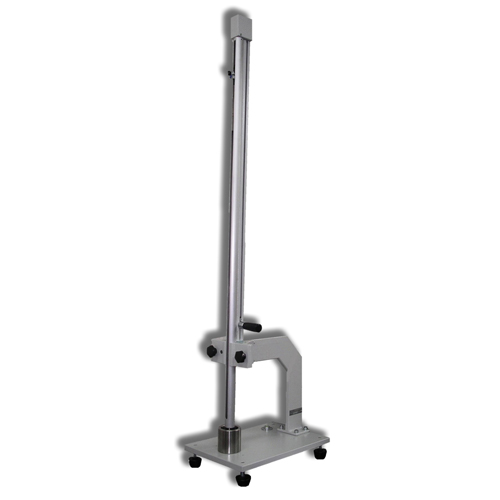
Manual Drop Impact Tester According to ASTM D 1998
- Steel guide with inner diameter according to the standard //
- Weights will be according to customer request per energy level //
- Sample holder as per above standard //
- Customers also need a deep freeze. in case of need, it will be added to the quotation- Also Cool bath to − 29°C (−20°F) by immersing small quantities of dry ice in isopropyl alcohol could be used as the bath medium to chill the specimens //
- Guide length of 2 m, 3m, … per customer request //
- Includes a leveling device //
- Graduated rod for easy height adjustment //
- Sample weight height adjustment is manual method //
- Rigid base for sample placement //
- Hemispherical impact head (According to above standard) //
- Release of weight is manual //
- Easy adjustment of mass drop height