

APPARENT DENSITY
Test Method A
- Scope
5.1 Test Method A (see Note 1) covers the measurement of the apparent density of the fine granules and powders that can be poured readily through a small funnel.
- Apparatus
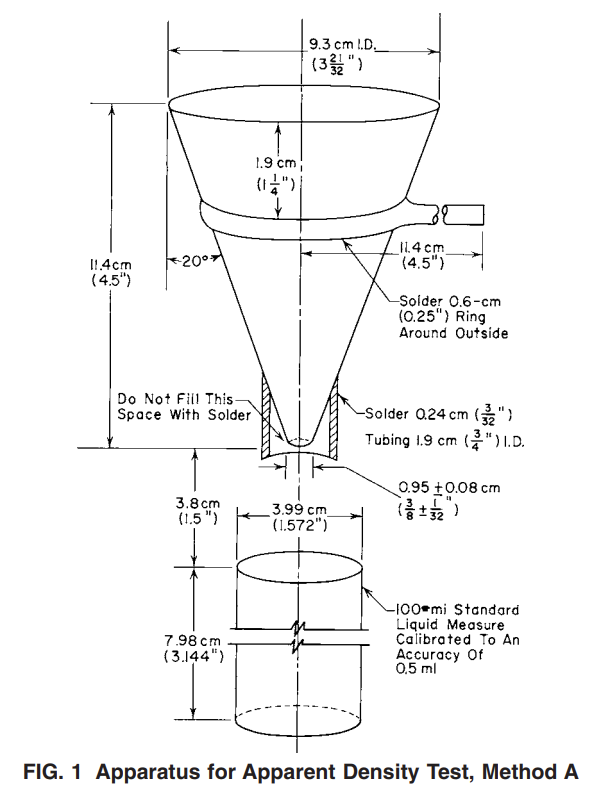
6.1 Measuring Cup—A cylindrical cup of 100 ± 0.5-cm capacity, having a diameter equal to half the height, for example, 39.9-mm (1.572-in.) inside diameter by 79.8-mm (3.144-in.) inside height, as shown in Fig. 1.
6.2 Funnel, having a 9.5-mm diameter opening at the bottom, and mounted at a height 38 mm above the measuring cup, as shown in Fig. 1.
- Procedure
7.1 With the apparatus assembled as shown in Fig. 1, close the small end of the funnel with the hand or with a suitable flat strip and pour a 115 ± 5-cm3 sample into the funnel. Open the bottom of the funnel quickly and allow the material to flow freely into the cup. If caking occurs in the funnel, the material may be loosened with a small glass rod.
7.2 After all the material has passed through the funnel, immediately scrape off the excess on the top of the cup with a straightedge without shaking the cup. Weigh the material in the cup to the nearest 0.1 g. Calculate the weight in grams of 1 cm3 of the material.
NOTE 2—To convert grams per cubic centimetre to ounces per cubic inch, multiply by 0.578. To convert to grams per cubic inch multiply by 16.39. To convert grams per cubic centimetre to pounds per cubic foot, multiply by 62.43.
NOTE 3—Apparent density figures are not comparable except on materials having the same specific gravity after molding or forming.
7.3 Very fine materials that will bridge and not flow through the funnel may be poured lightly from a paper held approximately 38 mm (1.5 in.) above the opening of the measuring cup.
Test Method B
- Scope
8.1 Test Method B covers the measurement of the apparent density of coarse, granular materials, including dice and pellets, that either cannot be poured or that pour with difficulty through the funnel described in Test Method A.
- Apparatus
9.1 Measuring Cup—A cylindrical cup of 400-cm3 capacity, as shown in Fig. 2.
9.2 Funnel, having a 25.4-mm (1-in.) diameter opening at the bottom, and mounted at a height 38 mm (1.5 in.) above the measuring cup, as shown in Fig. 2.
NOTE 4—Finely divided powders may collect electrostatic charges which, if present at the time of measurement, may result in variable apparent density values. Carbon black is a material that may be premixed with the sample at concentrations of 0.05 to 0.2 weight percent to reduce this variability (Superba Black with a bulk density of about 8 lb/ft3 has been found satisfactory for some materials).
- Procedure
10.1 With the apparatus assembled as shown in Fig. 2, close the small end of the funnel with the hand or with a suitable flat strip and pour a 500 ± 20-cm3 sample into the funnel. Open the bottom of the funnel quickly and allow the material to flow freely into the cup.
NOTE 5—The funnel described in Test Method B is also used for more finely divided powders such as vinyl resins. While these powders usually will pour through this funnel, they may bridge in the 400-cm3 cup shown in Fig. 2. To avoid this, the 100-cm3 cup shown in Fig. 1 may be substituted, and the sample reduced to 115 ± 5 cm3.
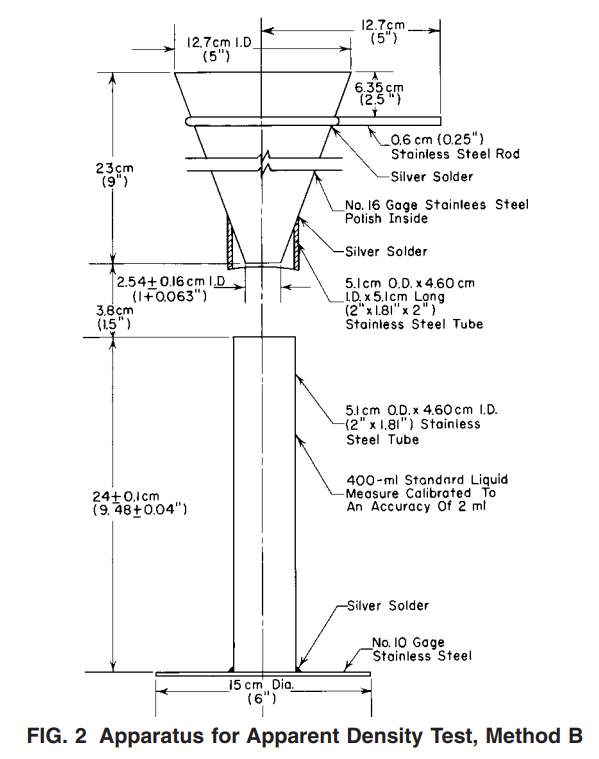
10.2 After all the material has passed through the funnel, immediately scrape off the excess on the top of the cup with a straightedge without shaking the cup. Weigh the material in the cup to the nearest 0.1 g; then calculate the weight in grams of 1 cm3 of the material. Make three determinations of the apparent density on each sample and average the results (Note 2).
Test Method C
- Scope
11.1 Test Method C (see Note 1) covers the measurement of the apparent density of materials supplied in the form of coarse flakes, chips, cut fibers, or strands. Such materials cannot be poured through the funnels described in Test Methods A and B. Also, since they ordinarily are very bulky when loosely poured and since they usually are compressible to a lesser bulk, even by hand, a measure of their density under a small load is appropriate and useful.
- Apparatus
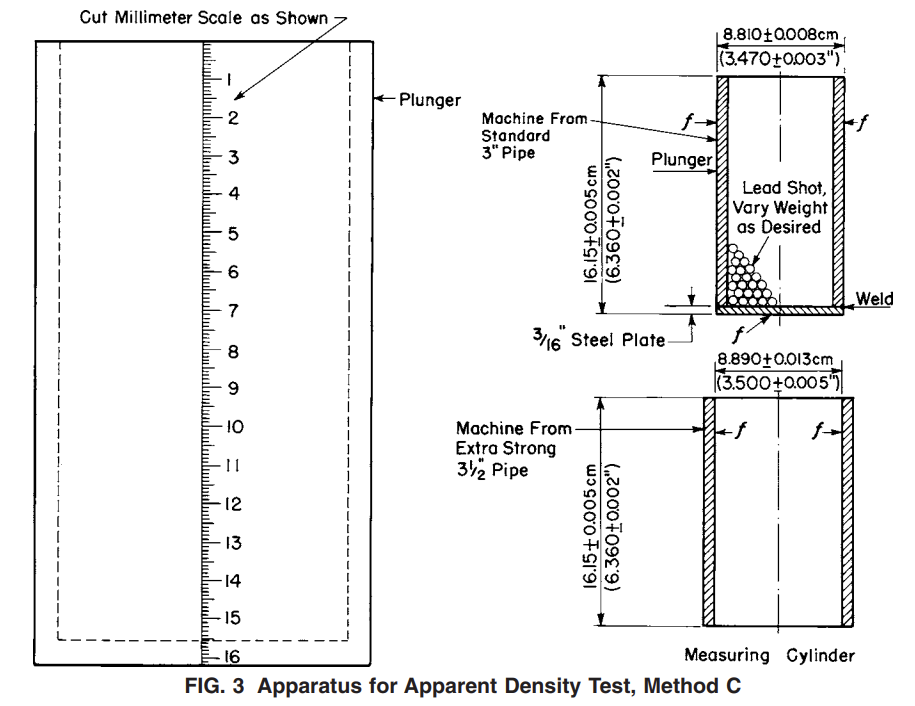
12.1 Measuring Cylinder—A cylinder of 1000-cm3 capacity, as shown in Fig. 3.
12.2 Weight Plunger—A cylinder closed at one end and having an outside diameter slightly smaller than the inside diameter of the measuring cylinder, as shown in Fig. 3. The plunger shall have a scale cut on the outside surface, graduated in intervals of 1 mm. - Procedure
13.1 Place the measuring cylinder on a piece of paper. Loosely drop 60 ± 0.2 g of the material to be tested into the measuring cylinder from a height approximately that of the cylinder, taking care to lose none of the material and to drop it as uniformly as practicable. Before applying the weight, level the material in the measuring cylinder. Measure the height of the loose material in centimetres and identify this measurement as H1.
13.2 Fill the weight plunger with lead shot to obtain a total weight of 2300 6 20 g (5.07 6 0.04 lb), including the plunger. Lower this weight gradually into the measuring cylinder until it is entirely supported by the material. Allow the weight to settle for 1 min and take the reading from the scale to the nearest 0.1 cm. This reading will give directly in centimetres the height, H2, of the material.
ASTM D 1895 Methods for Determining Apparent Density of Plastic Materials
Overview of ASTM D 1895
ASTM D 1895 is a widely recognized standard that defines methods for determining the apparent density, bulk factor, and pourability of plastic materials in powder, granular, or flake form. Apparent density is crucial for understanding how plastics will behave during storage, handling, and processing. The test helps producers and users of thermoplastic compounds gauge how these materials can be handled and processed in bulk. ASTM D 1895 outlines several test procedures to suit materials with different flow characteristics, with the objective of establishing reproducible and comparable density values for industrial applications.
- The standard covers test methods for plastic materials in powder, granular, or flake form.
- It is often used to specify material characteristics during production or quality control.
- Results are critical for determining material flow and compatibility with processing equipment.
Methods in ASTM D 1895
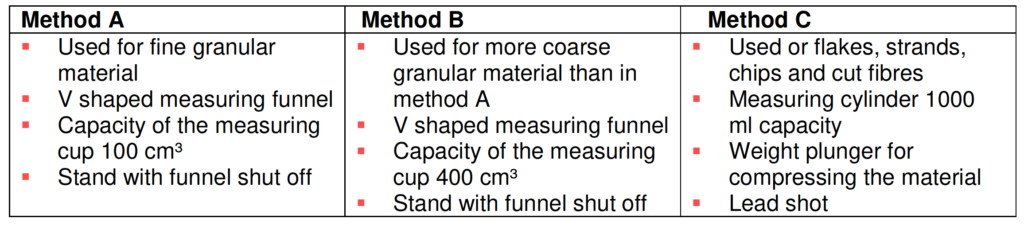
ASTM D 1895 provides four methods (A, B, C, and D), each designed for different material shapes and flow properties. Method A (Scott volumeter) is used for free-flowing powders, Method B (measuring funnel) for non-free-flowing materials, Method C (graduated cylinder) for flakes and coarse particles, and Method D for resin in cylindrical form. Each method specifies vessel shape, filling procedure, and measurement protocol to ensure test consistency.
Apparent density significance
Apparent density values provide guidance for transportation, packaging, and blending operations. They play a role in inventory decisions, shipping regulations, and process adjustments for manufacturing operations. Comparative apparent density values can indicate lot-to-lot uniformity or potential processing issues such as segregation, bridging, or ratholing in hoppers and silos. Accurate values allow more efficient design of storage and transfer systems for plastic processors and compounders.
Takeaway
ASTM D 1895 delivers defined procedures to measure the apparent density of various plastic materials, allowing manufacturers to optimize handling and processing. The selection of the suitable method is key to obtaining repeatable and credible results relevant to each material form.
- Standard defines four test methods for different plastic forms
- Apparent density linked to material flow and handling
- Used in quality control and process development
- Improves comparability of data between suppliers and users
Step by step guide for ASTM D 1895 plastic material density determination
Preparatory considerations
Before conducting the ASTM D 1895 test, select the appropriate method (A, B, C, or D) based on the form and flow properties of your plastic material. Ensure that all apparatus, including volumetric vessels, funnels, and balances, meet the dimension and tolerance requirements specified in the standard. Condition the material and equipment if necessary to regulate temperature and moisture, as environmental conditions can affect test accuracy.
Sample loading and measurement equipment
Prepare the test vessel according to the chosen method. For example, for Method A, use a Scott volumeter; for Method B, a standard funnel and receiving cup. Zero or tare the scale before each measurement. Pour the plastic material steadily into the designated vessel, following the prescribed pouring speed and height from the standard for reproducibility.
- Verify vessel cleanliness and dryness
- Ensure sample quantity exceeds vessel volume
- Follow consistent pouring protocol as outlined
Measuring and recording apparent density
Once the vessel is filled as specified, level the material surface with a straightedge if instructed by the standard. Weigh the filled vessel and subtract the vessel’s tare weight. Calculate apparent density as the mass of material divided by the known vessel volume. Repeat the process for additional replicates to ensure test reliability, as recommended by the standard.
Calculating and documenting results
Average the measured densities to obtain a representative value. Record all relevant details, including test method used, material type, environmental conditions, and individual density measurements. Document any deviations from the standard protocol, as these may impact result comparability.
- Use correct calculation for apparent density (g/cm³)
- Report average of replicated tests
- Record testing conditions and any deviations
- Compare results to specification limits as needed
- Retain all raw data for traceability
Reporting and interpretation of findings
Prepare a summary of the test, referencing the specific ASTM D 1895 method utilized, the average apparent density value, and any observations about material behavior during testing (e.g., bridging, poor flow). Compare results to internal specifications or material data sheets to determine acceptability for the intended application. Communicate findings to quality, production, or technical staff as required for decision making.
Summary
Carefully following ASTM D 1895 enables accurate, meaningful measurement of apparent density for plastic powders, granules, and flakes. The method selected should match material properties, and thorough documentation ensures data is reliable and actionable for processing and quality control.
- Choosing the correct method ensures data relevance
- Precise protocol and calculations yield reliable results
- Reporting details facilitate compliance and evaluation
3 Devices from AHP PLASTIK MAKINA are available:
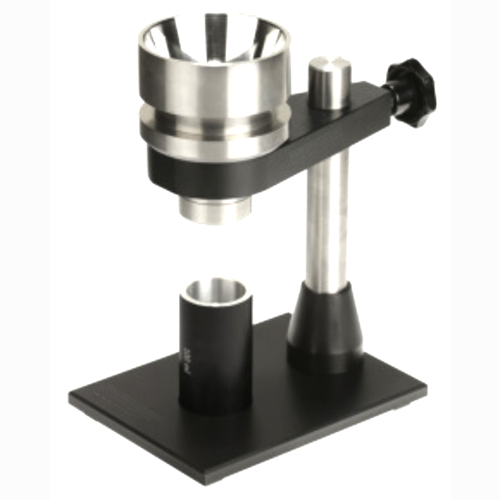
Bulk Density Tester According to ASTM D1895-Method A
- Measuring Cup—A cylindrical cup of 100 ± 0.5-cm
- Funnel, having a 9.5-mm diameter
- Simple set-up
- Compact construction
- Easy maintenance
- High accuracy and reliability